Nov. 22, 2026: Day 2 of the La Wayaka residency started at 9 AM with a morning called Following Seeds, led by a local expert who walked us through gardens and introduced us to local seeds, plants, and how things get grown here, along with a lot of the knowledge that goes with them: how seeds are cultivated, saved, and understood in this particular place. It resulted in a comprehensive storyline about ecological and agricultural history in the Atacama, including who holds knowledge, who keeps a community together, and what happens when decisions about your water get made somewhere else.
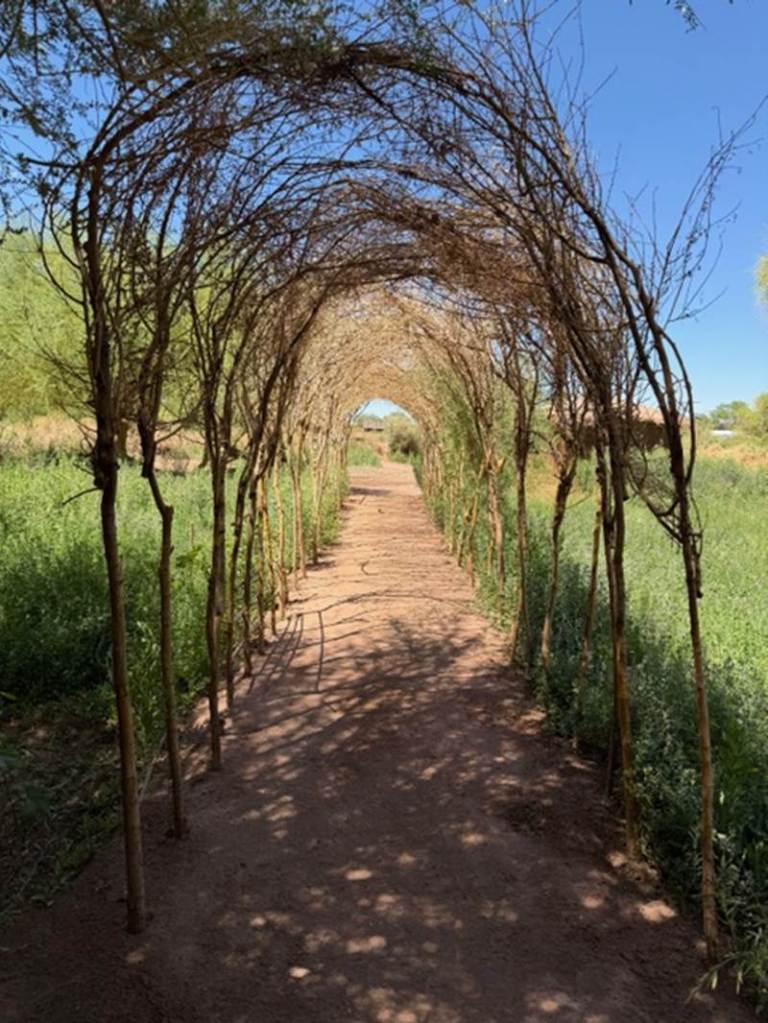
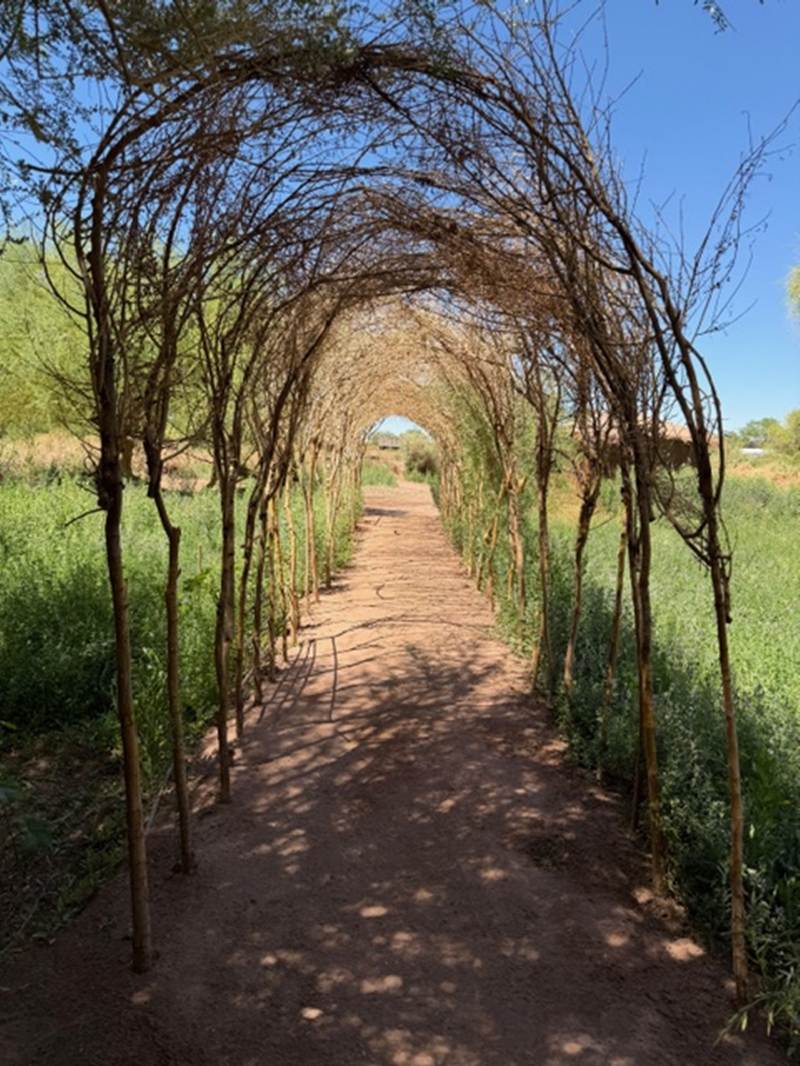
Bare branches, big drama. Best entrance I’ve walked through in a while.
Seeds, and the people who keep them
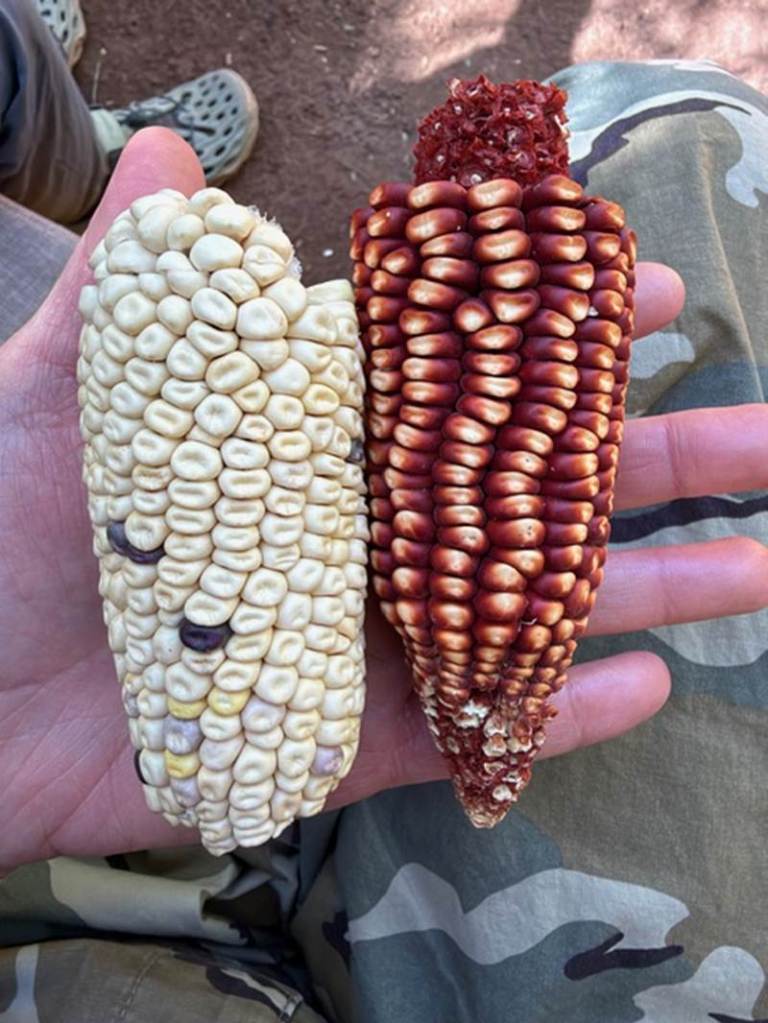
We sat in the shade on a low bench while our host drew in the dirt with a long stick. He was mapping out how water and seeds together turned into agriculture and real, nourishing food, starting with the trickle of water coming down from the Andes. Then he finished the drawing with by passing around actual seeds and ears of corn. One ear was creamy white with a few purple and yellow kernels scattered through it, like someone dropped confetti. The other was deep reddish brown in tidy rows, with tiny dark red kernels at the tip. A map drawn in dirt is a frame too, by the way. Our host chose where the story starts (water coming down from the Andes), and where you start a story decides a whole lot about what ends up in it.
For a moment, holding those two ears took me straight back to southwest Kansas. I grew up in an agricultural community, and my dad was a farmer most of his adult life. Many a summer, I grazed my way through sweet corn fields and helped fill the back of a pickup with ears to preserve for later in the year. I remember doing this with both sides of my family, my mom’s and my dad’s. After the sun got hot, my mom would set up in the backyard and we’d build an assembly line: cut the kernels off the cobs, scoop them into big ziploc bags, and send them straight to the freezer. My dad grew many types of corn, along with wheat, soybeans, and sunflowers, so cobs like these were always sitting around in his truck or in his shop. I never expected this trip to bring me back to an agricultural place, but here I am.
I went digging afterward, and none of it surprised me. Farmers in the Atacama oases have grown corn for centuries, along with beans, squash, potatoes, and cotton, mostly on terraces fertilized with llama dung and watered on strict schedules. The river water is salty, with a little boron and arsenic in it, and over generations people picked crops that could handle that. What I was holding looks like Andean heirloom maize, a local landrace and not the commercial stuff. The white ear with stray purple and yellow kernels likely cross-pollinated with other colors growing nearby. Deep red maize like the other ear often goes into chicha and toasted corn. I can’t tell you the variety names, and I want to ask, because names like that often carry family or ayllu history. One study of 2,000-year-old corn from farther north, in Tarapacá, found the old corn had less genetic variety than what’s grown there today, and that cobs and kernels got bigger over time. So the pale ear in my hand could be a few generations of choices or a whole lot more. I wish I had access to my photos at home while I’m writing this, so I could remember the colors of the corn my dad and his brothers grew in Kansas.
There were baskets, too, and it turns out they held the two big food trees of the oases. One basket had smooth, oval seeds in tan, orange, and reddish brown. I think those are pits from dried chañar fruit, which gets boiled down into arrope de chañar, a dark syrup people also take as a cough remedy. The other had long, curved, dried pods, some pale, some purple-brown, and I believe (?) they are algarrobo.
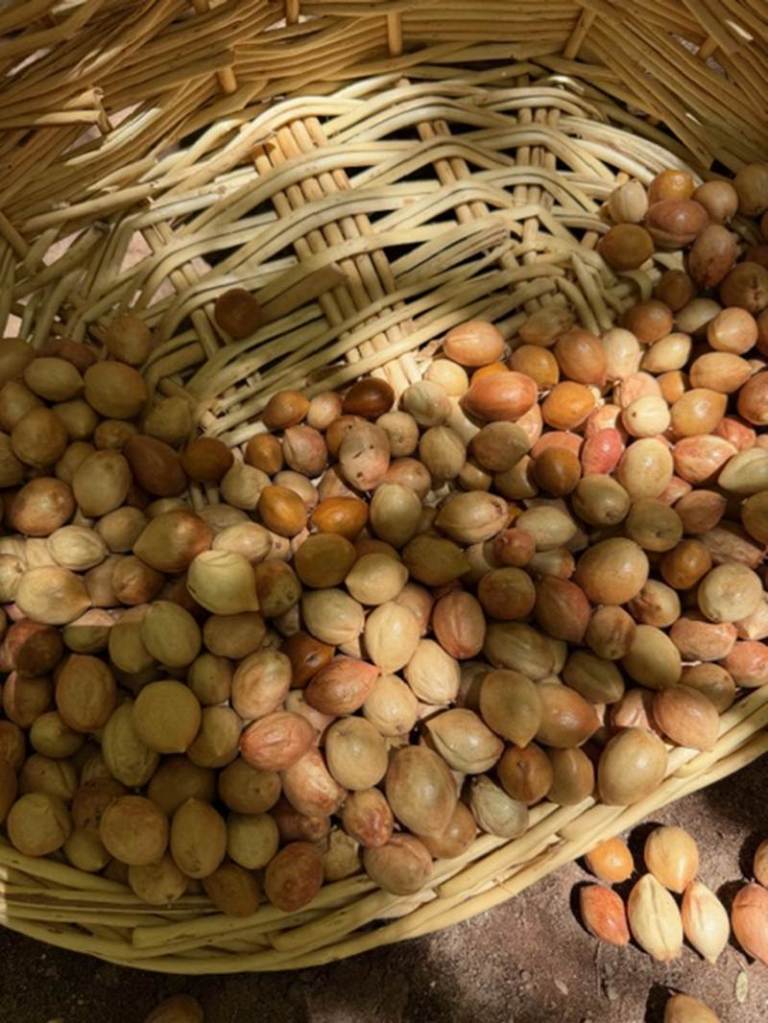
Chañar pits, tiny treasure energy.
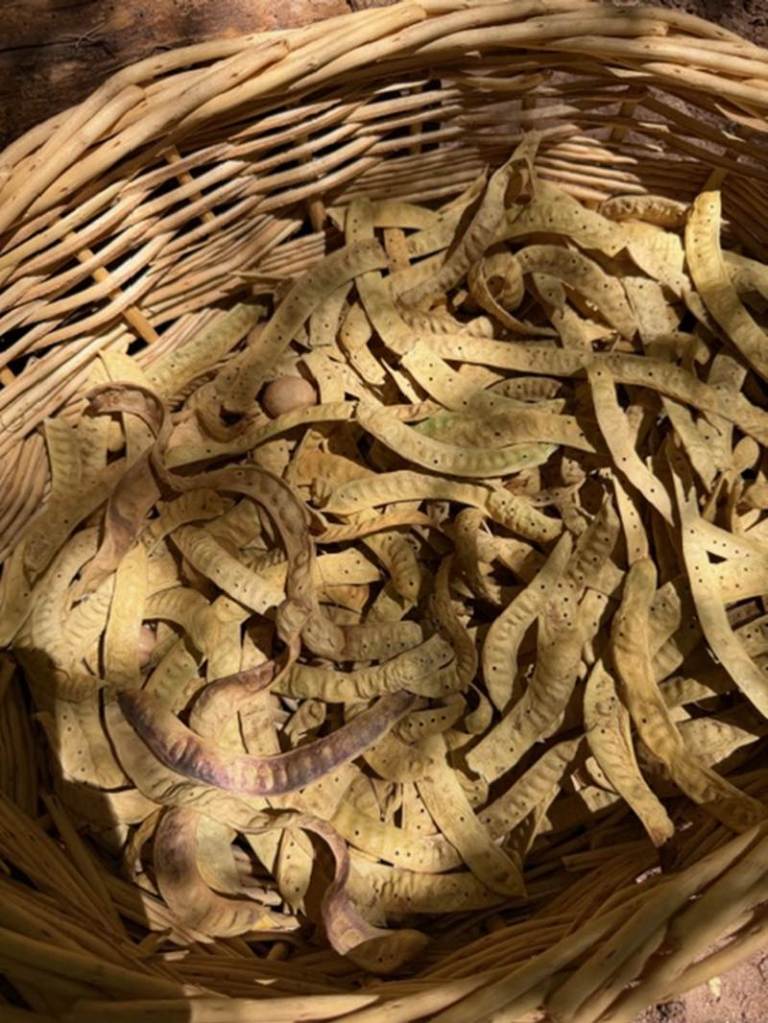
Algarrobo pods. The holes are where tiny squatters moved out.
Algarrobo (Prosopis) is basically mesquite’s South American cousin, and it grows across the dry parts of Peru, Bolivia, and northern Chile. The pods are naturally sweet. People grind them into flour for patay, a kind of cake, or soak them for añapa (a sweet drink) or aloja (a fermented one). They feed animals too, and the wood burns for cooking and heat.
A seed is a pile of decisions somebody made: which one to save, when to plant it, how much water it’ll want, how it tastes when you cook it. I think that’s what “situated knowledge” means. It lives in a place, in hands, in a family, and it doesn’t travel well without the people who hold it. I keep looping back to that.
There’s a water thread here too, and I almost missed it. Algarrobo and chañar are both deep-rooted trees that survive by tapping groundwater, and what happens to them is tied up with the water fights here in this part of the world. So even a basket of pods and pits has water politics in it.
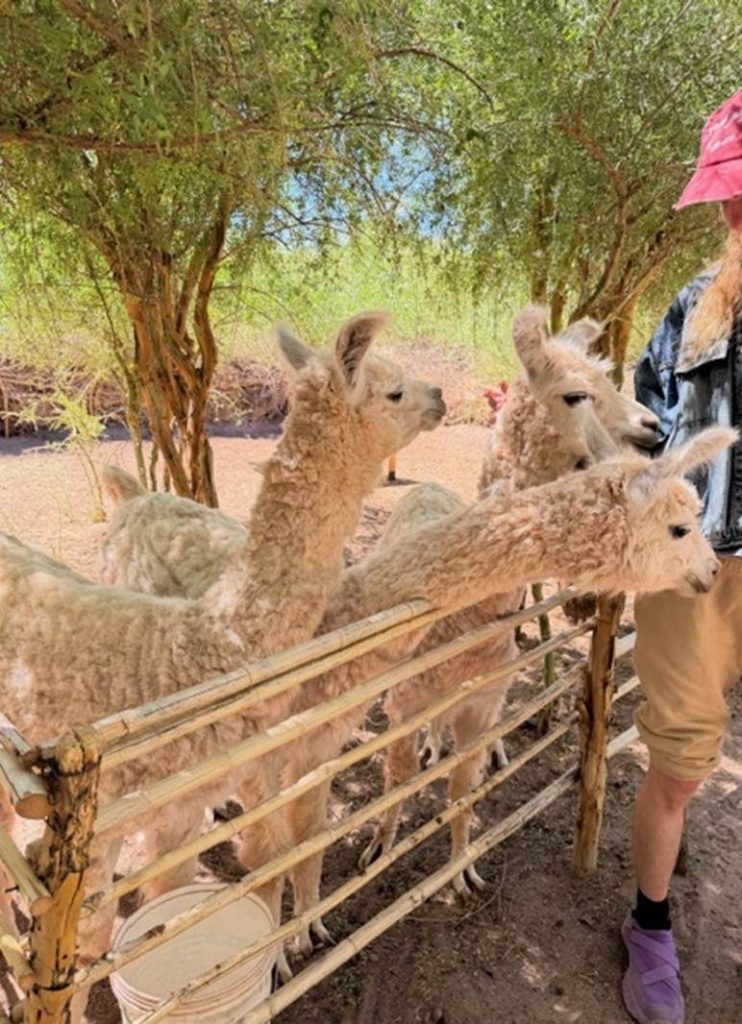
Three necks intertwined during our visit.
From seed to bread
Then we ate, which is its own kind of learning. Flatbreads on a metal rack over an open fire ringed with big rocks, a clay pot brimming with Rica Rica. Later a round table cut from a slice of tree showed up with more flatbread, sliced white cheese, little clay bowls of chopped red and green relish, and a tiny bowl of honey with a dipper. I ate a warm flatbread stuffed with fresh tomato, wrapped in a paper napkin, sitting on sandy ground in the dappled shade. Easily one of the best meals I’ve had in years. The clay bowls made me think of the black and red pots in the Tulor museum, the ones for living and the ones for burying. The chopped tomato salsa, by the way, is called pebre, and you get it all over San Pedro and the rest of Chile. Finely diced tomatoes, white or green onions, cilantro, garlic, oil, vinegar or lemon juice, and ají, the Chilean chili pepper. Restaurants plop a little bowl on the table with warm bread while you wait for your food.
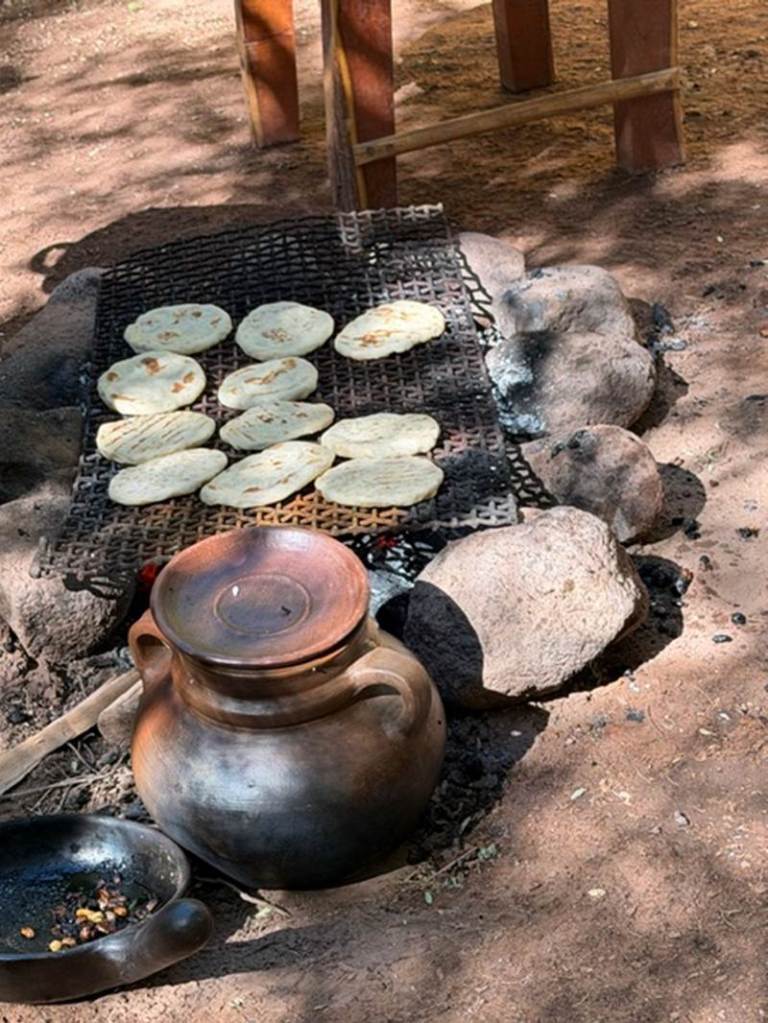
Flatbreads on the fire, with a pot of Rica Rica bubbling next door. We’ve all be ingesting the Rica Rica for upset tummies and altitude sickness.
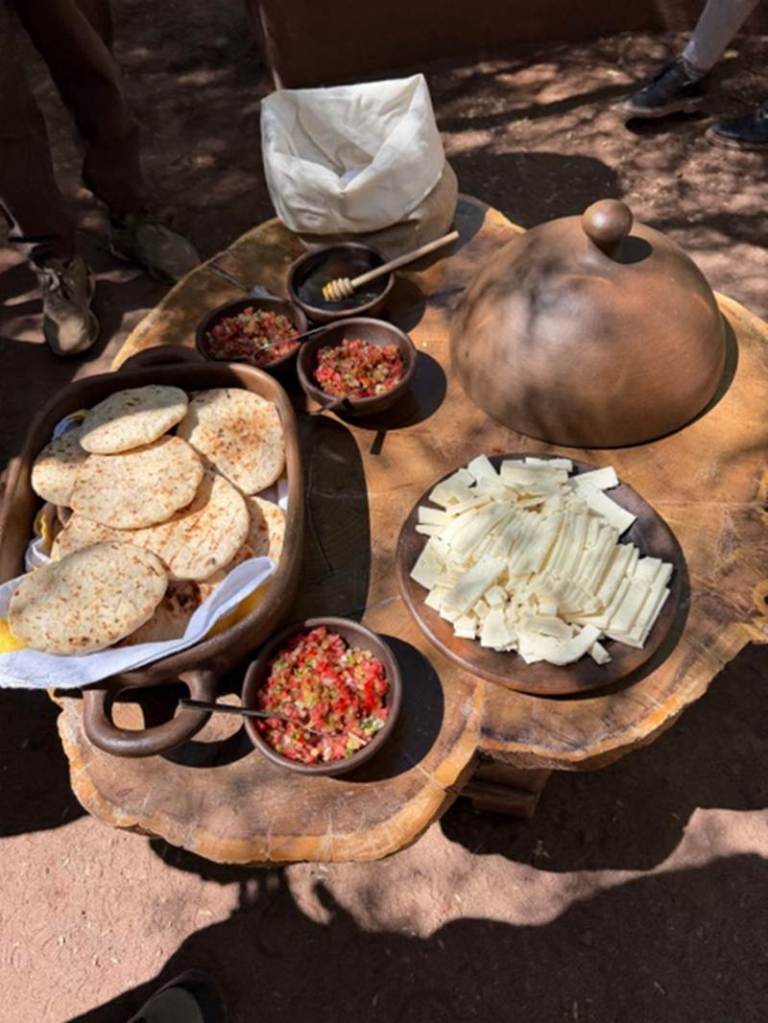
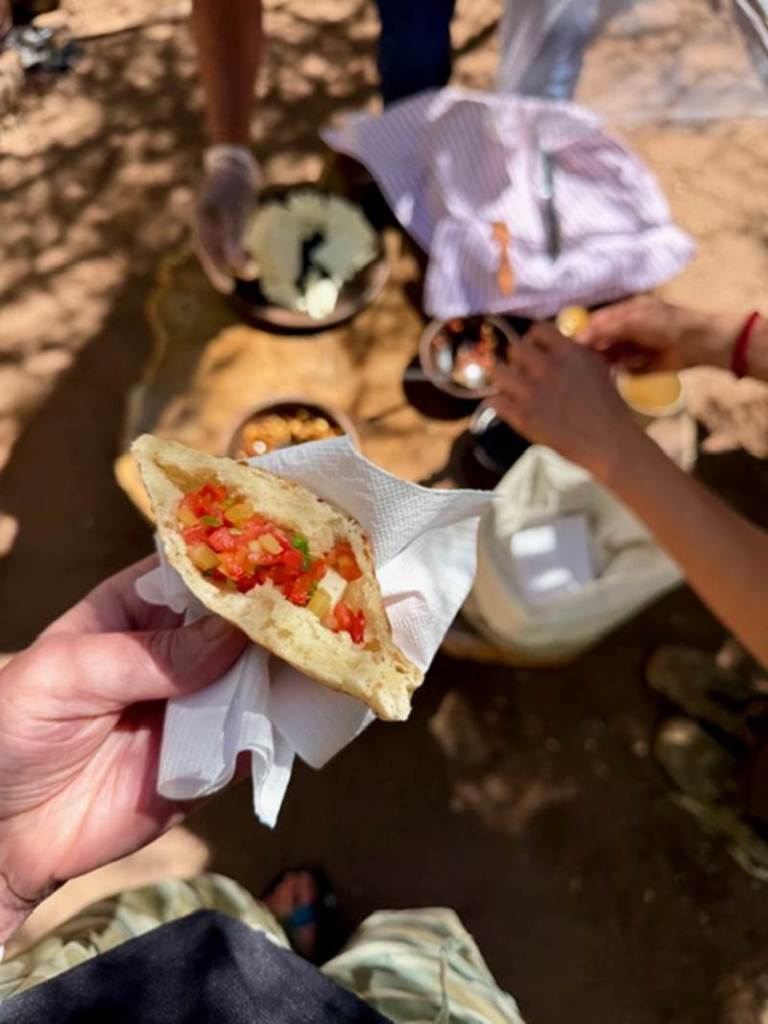
Early lunch, late breakfast = lubref.
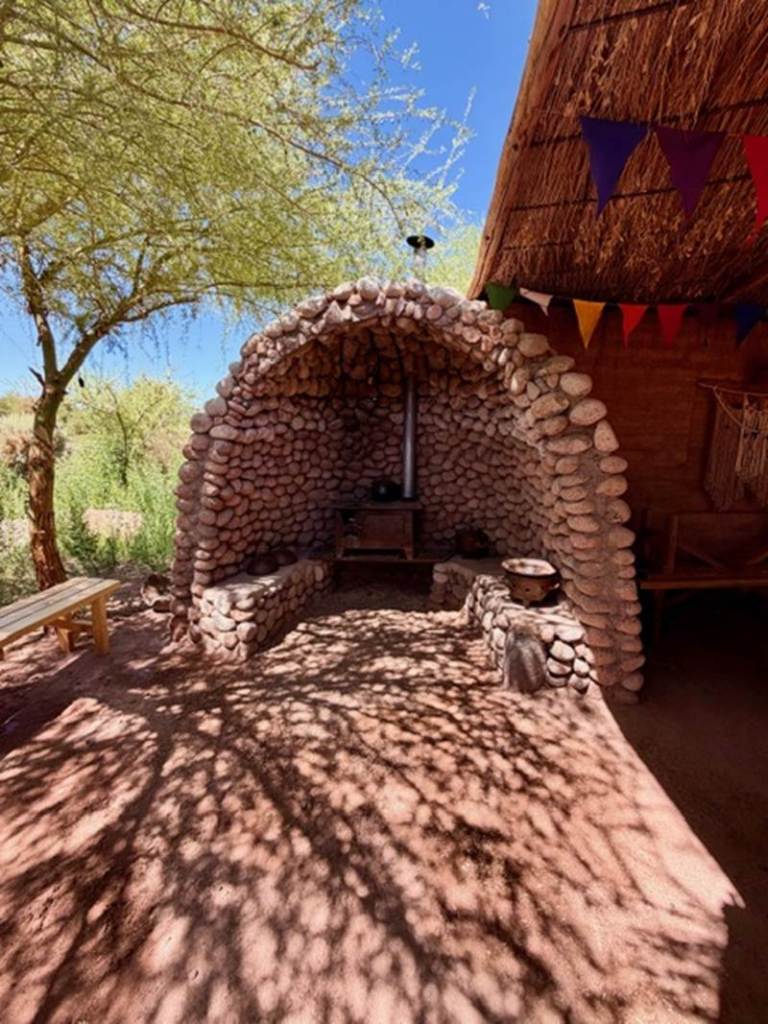
A stone alcove, next to a thatched-roof adobe building strung with colorful flags. This is the outdoor kitchen of our dreams!
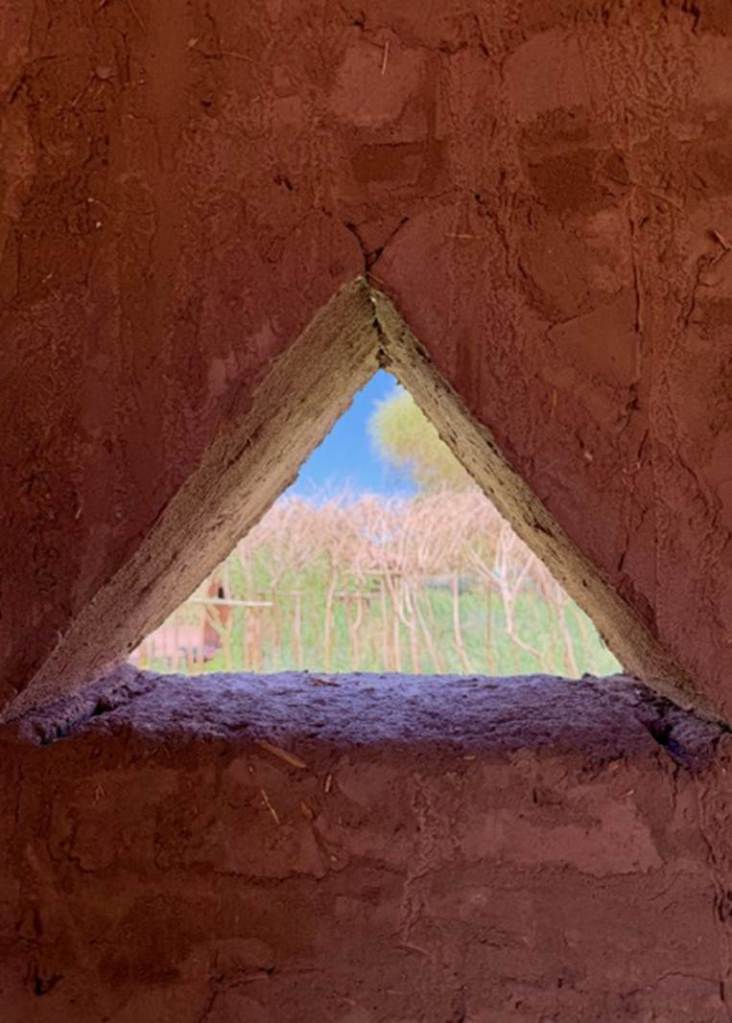
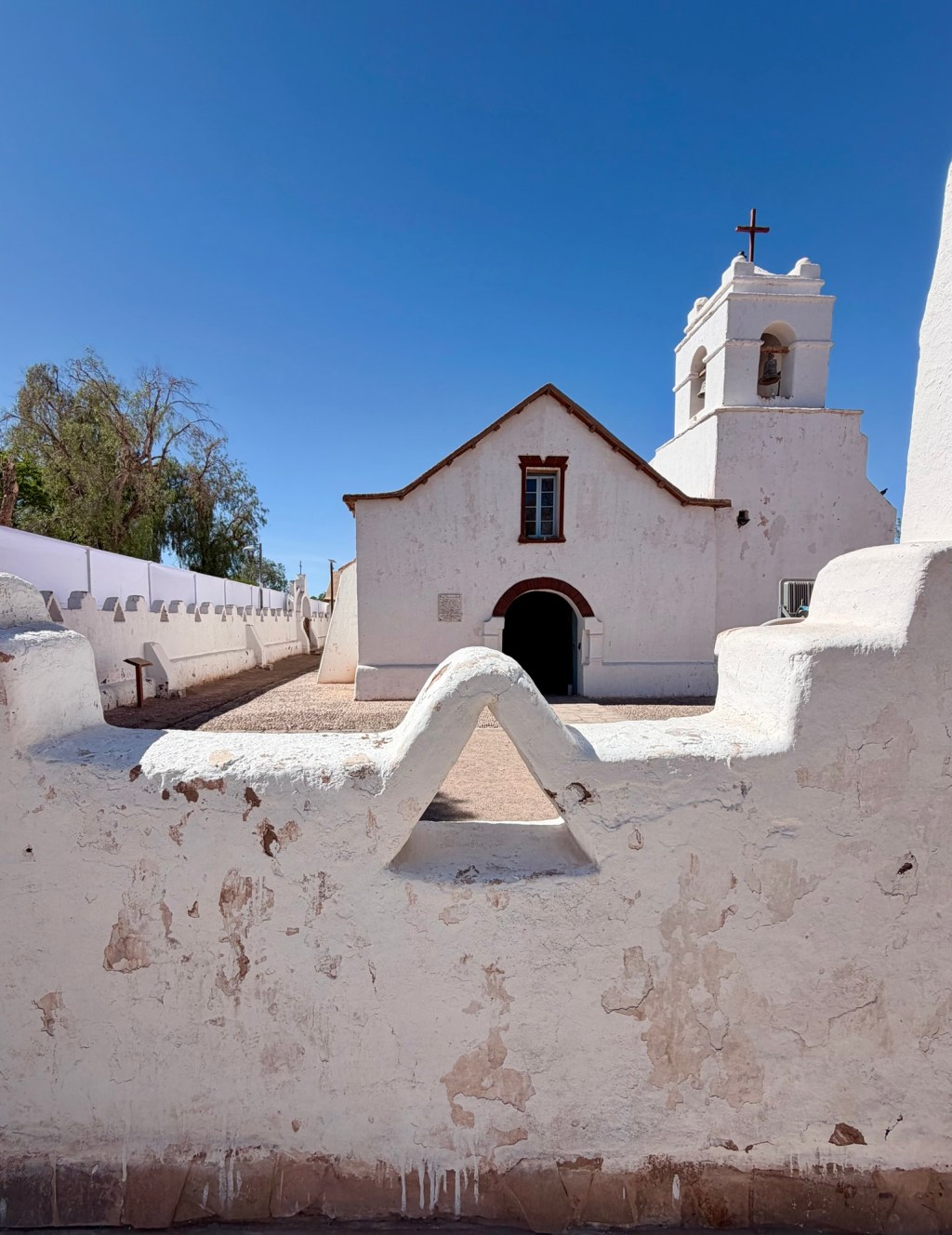
A triangular window near the outdoor kitchen in a thick adobe wall, straw fibers and all. Earth, fiber, and sun: the original recipe, and it still looks good.
I keep thinking about the chain of how all these pieces fit together. A seed becomes corn, corn becomes bread, bread gets shared under a tree. Every link needs somebody who knows how, and a place that lets them. And every single link needs water.
The story of community
After the seeds, we sat and learned about the community. I’ll share what I heard as best I can, with a few caveats. It came through translation, I’m working from a recording that got garbled, and I’m a guest. This is one person’s account, one perspective. I left names out on purpose.
At the beginning only about a dozen people lived in the community. And what they understood by “community” was caring. Responsibility to each other. Wealth that belonged to the group, not to individuals. What they cared about most was water. If they could see a year coming with very little of it, they organized so there’d be enough for everyone. Water meant land, land meant food, and the trees, air, and land were sacred to the old people. Caring for all of it was the whole point.
Then things changed. Along came what some viewed as progress, meaning extractive industries eyeing opportunities for a bottom line, but the idea of community started to water down into something else. As this happens, people leave and “comunero” doesn’t mean what it used to. It used to be an elder who protected the land and showed up to the meetings. Now it can be someone who’s registered but lives somewhere else.
Money came up, too. Companies who extract resources from a place tend to give funds to the community, but it’s usually up to them to direct the use. In my hometown, it’s natural gas. That part of southwest Kansas happens to be the largest natural gas field in America. Like any place, it’s always better when money goes toward access to water, infrastructure, better schools, health care services, protecting the identity and culture of a community, etc. The wishes here are similar to those in many small or rural places in Kansas, Colorado, and beyond: education and opportunities so young people could become their own professionals and defend their people instead of leaving to find opportunity somewhere else.
Then came the part that stuck with me most, or not. Beyond extracting and investing in a community, it’s the same story I see and hear about in the U.S. Someone else outside the community has the mechanisms to make laws, sell water and land, and hand out permissions, while the community itself has little influence. The news of decisions and future state make their way back to the people only after it’s too late. Everything had already been sold or done, legally. In our discussion, I believe this was described as an “invisible world” — that is, working through institutions.
Much like what I hear from advocates in Colorado who are pushing back on power-driven decisions that don’t consider community needs or voice, public opposition can be risky and fatiguing when it goes on for years and years.
Why this belongs next to the seeds
I came to the Atacama with questions about land, water, extraction, and who gets to tell the story. I did not expect to run into all of them on day 2, next to a basket of seeds. But here we are. Situated knowledge only holds if the people who carry it are still around, still organized, still informed. When they leave, or when decisions get made in a room and a language they can’t get into, the knowledge thins out. So does the power.
In fairness, people here are working on exactly this. I found a publication from Fundación Tantí and the Comunidad Indígena Atacameña de Coyo, made together between 2024 and 2026, that pairs traditional lickanantay farming knowledge with agroecology. Soil, water, seeds, crops, natural pest control, reusing greywater, with water scarcity front and center. You can read it here in Spanish or English. This knowledge isn’t just sitting in a basket somewhere. People are actively holding onto it.
And there’s a frame thing in here, of course. “Community” means one thing to the person who remembers a dozen people looking after each other’s water, and something else when it comes to the list of people who stay or leave a place. Same word, different boundaries. Who’s in, who’s out? The people who actually live here ended up outside the frame when the water decisions got made. Widening the frame, in this case, is pretty literal: who gets a seat in the room, and who finds out in time.
“By the time the news arrived to us, it was too late.” I wrote that down and underlined it twice. It’s an information problem, and it’s the kind I work on. It’s the whole case for local news, for plain-language explanations of what’s being decided and who’s deciding it, and for communities having their own advisers and professionals. It also loops back to the chasqui post: a relay of trusted people carrying the news in time for it to matter.
It hits close to home, too. Rural Colorado isn’t the Atacama and I don’t want to flatten the two. But rural places in both absorb the consequences of decisions made somewhere else, and water is part of both stories. And I work for a foundation, which makes me part of the question of what funders do with what they hold. I don’t have a tidy answer. I just want to keep it in front of me.
I’m trying to hold all of this “lightly”, as a good friend of mine often says.
This day might be the clearest picture of my case statement so far. Stories and usable information are what healthy communities run on. Here the news came too late, the decisions got made somewhere else, and power piled up with the people who benefit from nobody knowing. When I write about the importance of robust information ecosystems that center land, place, territory, community, and environmental justice, this is what I mean. Not in the abstract. A community that gets its news in time or in a way that actually makes meaning of something important, in a form it can use, with its own people ready to act on it.
The rest of the day
After a morning of pure bliss, I digested my notes and recordings in the outdoor common area, which is beautiful and peaceful. Dappled shade, dry dirt, wooden benches and log seats scattered around, a low adobe wall nearby. I sat down at a table to start getting the morning on paper. (My handwriting got messier the longer I went. Typical.)
That’s when I heard meowing. At that point, I hadn’t seen a single cat in Chile yet. Tons of dogs, but no cats. So I made the little sound I make for my cats at home, and sure enough, a calico appeared. She walked right up to me, meowing over and over. She was a beautiful and friendly cat, and circled my legs for a few minutes like she already knew me.
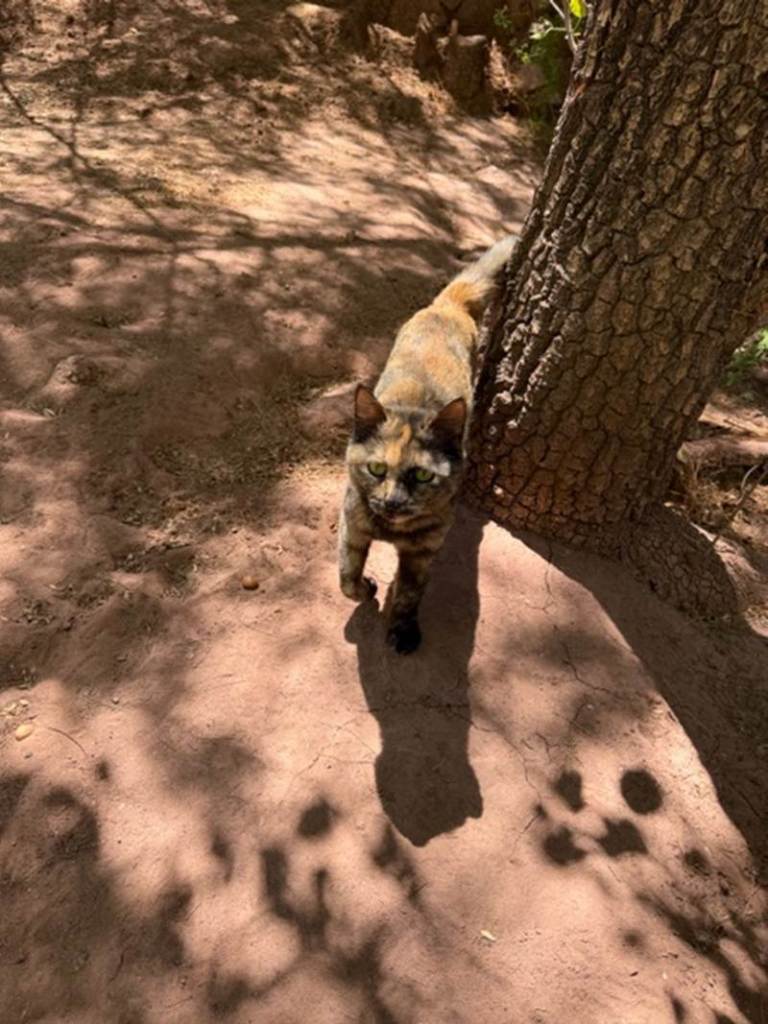
Calico on approach. She had somewhere to be, and it was me.
I gestured for her to jump on the table and lie down, and she did. Sort of. She was restless, eyes darting around, jumpy at every sound outside. She’d lie down and relax, then pop back up and demand my attention. She was persistent, and at one point she lay down right where my notebook was so I couldn’t write. Even while I’m writing this down, she’s on my legs, then back up on the table, watching, meowing, watching, meowing.
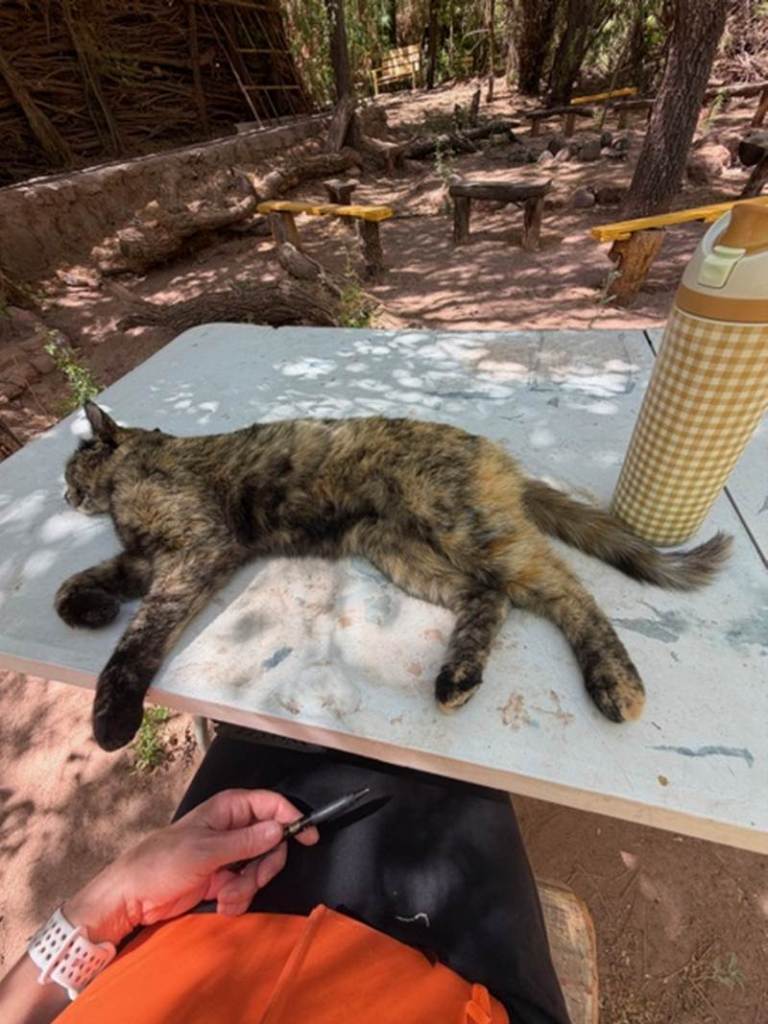
Exhibit A: the cat, the table, and the spot where my notebook used to be.
Her frame for that table was simpler than mine: warm spot, mine. After a morning about seeds, water, and who holds knowledge, getting bumped off my own notebook by a cat felt about right. I came here to practice slowing down, and she wasn’t about to let me write my way around it. Turns out I made a friend. I’ve been visiting her every day since. She’s also made herself known across the entire residency base, and everyone seems to love her presence.
I ended the day watching the sunset in the desert. Pale blue-gray sky going peach and orange near the horizon, lavender mountains, a nearly full moon over the flat plain, gold scrub, red sand. I took pictures (of course I did), and every one of them crops the world down to a rectangle, which is its own frame, a pretty one that leaves most of the sky out. But mostly I just stood there and looked. I didn’t write anything down, and for once I didn’t try to turn it into a takeaway.
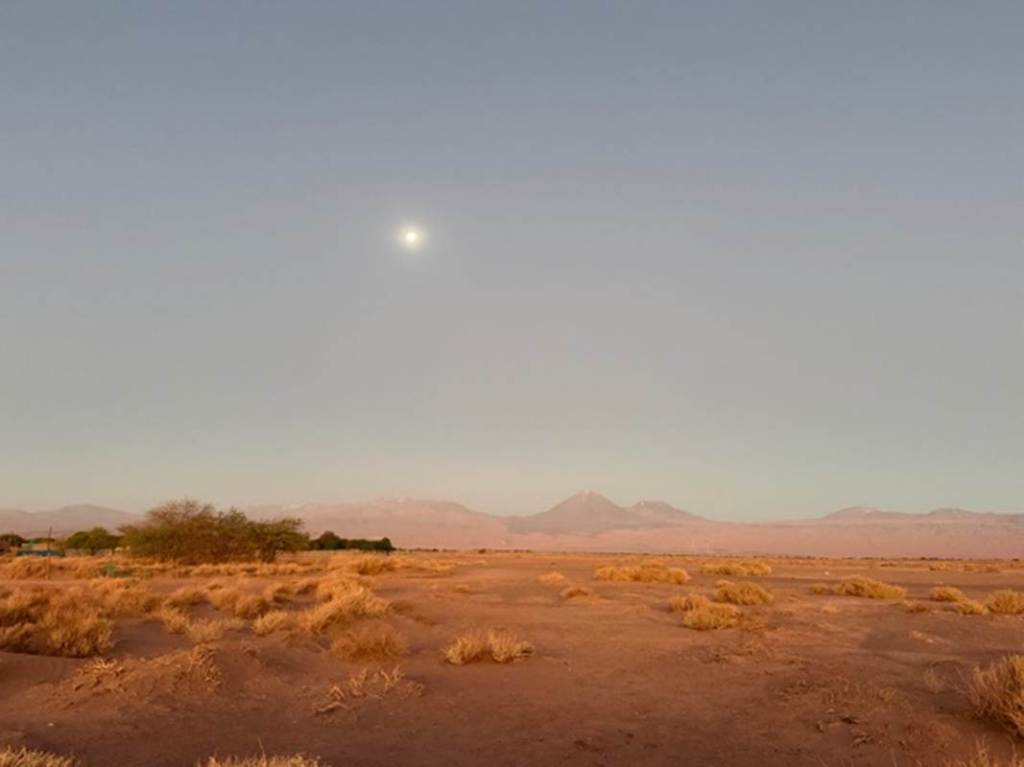
The moon showed up early to the sunset party.
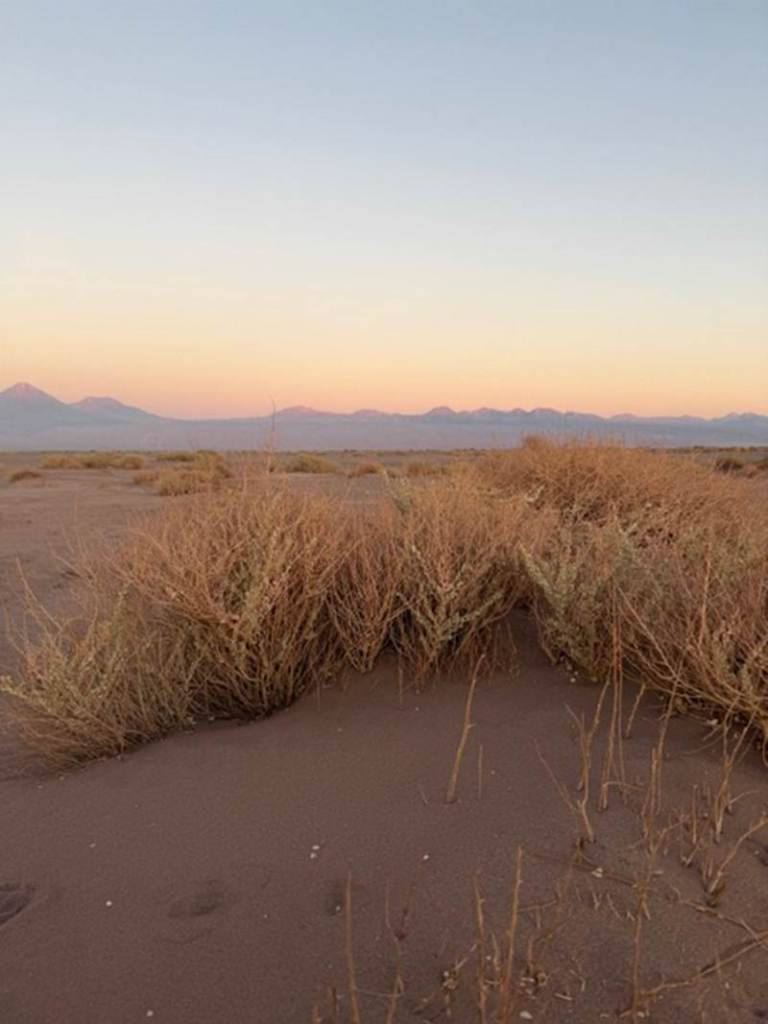
Golden hour doing its thing.
Things I’m Thinking About
- How do communities get the opportunity to learn about, weigh in on, or hear about decisions in time? What parts of the civic infrastructure need resources and the opportunity to do this?
- This day is what sparked my current research concept. A map drawn in dirt, a basket of seeds, a shared meal, and one person’s story about water did the work of an information system, and none of it was a report or a news story. What if stories about place, told through craft, paintings, food, ceremony, and local cultural events, count as civic infrastructure, right alongside roads, libraries, and local news?
Sources: Based on a voice recording of the morning session (auto-transcribed and translated, so parts are garbled), my photos, my handwritten notebook notes from the afternoon, and some background research afterward. If you notice an error, please contact me.

Leave a Reply