Friday, Nov. 21, was the first day of my residency, and I had a few hours in San Pedro de Atacama before the residents were picked up for the evening. I spent them the way I learn any place: on foot, phone in hand, seeing and observing.
While I’m not a professional photographer, we all get away with documenting on our phones. I take photos to memorialize and to frame a moment. In reflecting on my first day in San Pedro and cruising through my photo stream, I was struck that no matter my intention, every photo meant deciding what to include and what to leave at the edge. This is a question I left Santiago with: what does a frame leave at the edge? In San Pedro it grew into a second one: who draws the frame, and can it be widened?
A gallery with a mine behind it
My first stop on Friday was the Sala de Arte, a free public gallery and community center run by Fundación Minera Escondida. The foundation was created in 1996 as the community arm of Minera Escondida, the Antofagasta Region copper operation majority-owned by BHP and the world’s largest copper mine by production. This year, it marks its 30th anniversary.
As I explored the community center space, I wondered: Who decides what gets shown here? In this case, part of the answer is public. The exhibition by artist Eduardo Breems is one of the winning projects of the 2026 Convocatoria de Artes Visuales, an open call presented by Fundación Minera Escondida, Escondida | BHP and Fundación Cultural Dibujona. That is a frame, too: a selection process that decides which artists and ideas reach the wall. A frame decides what is seen and what is left at the edge, and a gallery’s choices about what to show are one version of that, just as my own photos were. Every institution, and every one of us, chooses a frame for how we show up. Those are fair questions for a gallery, a funder, a newsroom, or a traveler with a camera.
The context matters. San Pedro sits in Atacameño-Lickanantay territory, where mining, lithium, tourism, and water shape the economy, the landscape, and the conversation about whose future is being planned and by whom. Even the town’s Centro Cultural, opened in 2023, was built with funds from an agreement with Albemarle, a lithium company. Industry, tourism, government, and Indigenous communities each frame the same landscape differently, and those frames do not always fit in one picture.
Layers of ink
The exhibition, Impresiones de la fe: Reinterpretaciones desde la técnica serigráfica (Impressions of Faith: Reinterpretations from the Screenprinting Technique), is by graphic designer and visual artist Eduardo Breems. It grew out of a project in the graphic design program at the Universidad de Antofagasta, and it uses screenprinting to reinterpret the dances, processions and promises of northern Chile’s popular religious festivals. He starts with photographs, then fragments and rebuilds the images, separating their colors into overlapping layers of ink, so the documentary becomes interpretation and digital precision meets the materiality of ink and handwork. Each layer is a choice about what to let through the screen, the literal frame of the printing process, and the finished image carries all of them at once: a frame that shows its own making. The show is free and open through December, with screenprinting workshops and guided tours alongside it. In Santiago, I mostly noticed what a frame leaves out. Here, the frame felt less like a boundary and more like something made, and anything made can be remade.
A lecture was underway while I was there, and I could not follow it given my Spanish is limited. I stood at the edge of a conversation where language itself was the boundary. Widening a frame may start with accepting that some rooms were not built for me, and that the work is to listen from the edge rather than step to the center.
A building that remembers
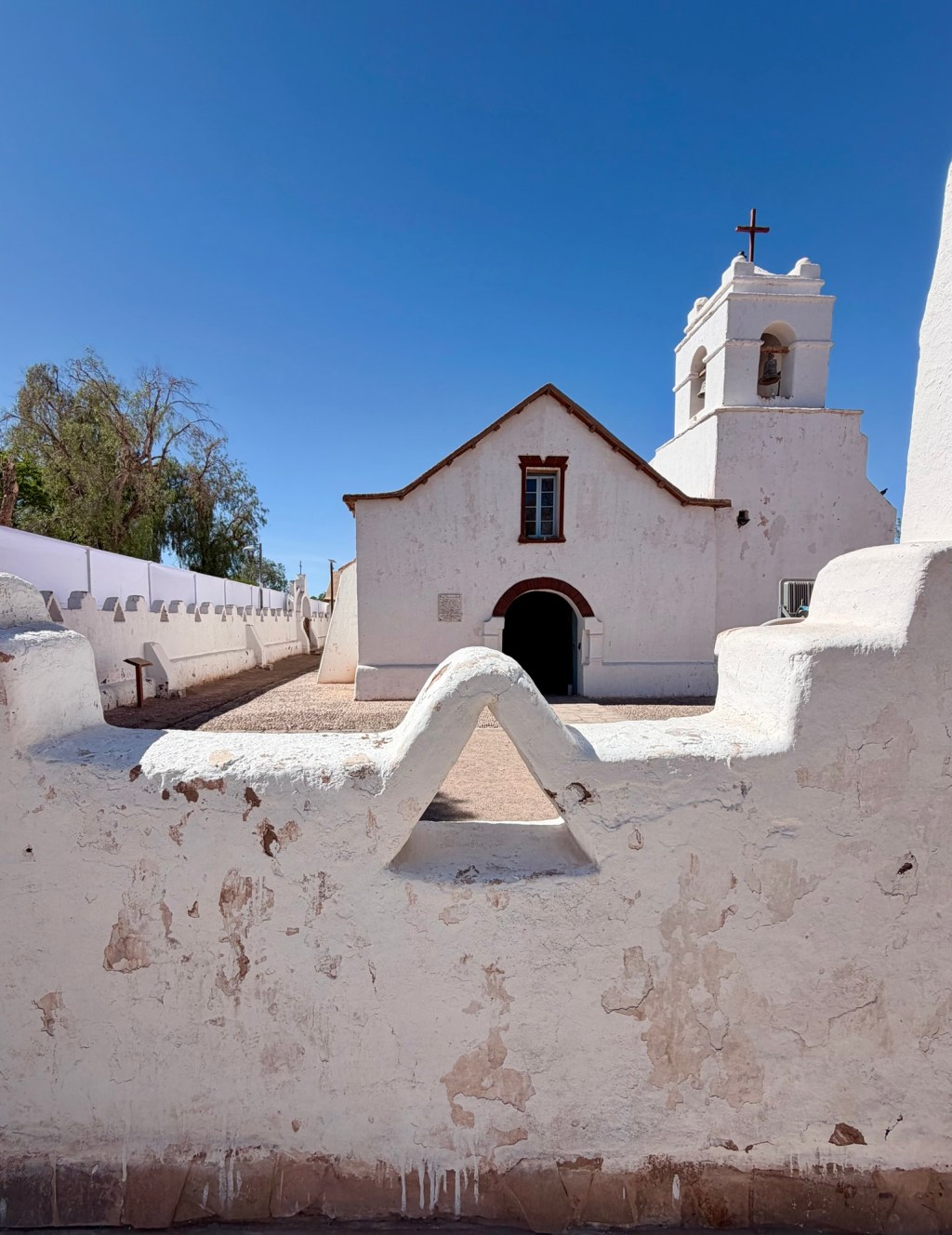
From the gallery, I walked to the Church of San Pedro. Chile’s National Monuments Council describes a church first built in 1557, with today’s structure the result of a mid-18th-century expansion, and the largest of the Atacameño churches. The walls are thick adobe, and the roof is algarrobo and chañar wood and cactus, bound with leather rather than nails: a building made entirely from what the desert provides. Restoration that began in 2014 uncovered two previously unknown paintings of angels, a reminder that what a frame once covered can come back into view.
The council also notes that Christianity took hold here through cultural syncretism, which can be read as a frame widened over time, though it raises the question of who did the widening and on whose terms. In the gallery and the church alike, faith and ritual are how a community remembers, often outside official records.
Standing between a gallery and a centuries-old church, I kept returning to one question that belongs to anyone who cares about a place, whether you live there, visit it, write about it or help fund the work happening in it: who drew the picture I am looking at, and what did it leave out? What am I leaving out, as I view?
The title of this post plays on two words that sound alike but do different work. A frame limits what we see. A framework is something we build: a structure that can hold more people, more information and more perspectives than any single frame. Moving from one to the other is the work.
Here is how I am trying to hold it:
1. Every picture of a place is drawn inside a frame. The frame decides what counts as a problem, a solution, a beautiful view or a fact worth knowing. It is also a lens for need: the assumptions that decide what counts as a need, a solution or evidence also decide what gets noticed, protected and funded. What sits outside it is easy to miss, and easy to leave unprotected, unfunded and unheard.
2. Information, stories and narratives are what a frame is made of. Information is the raw material: the facts, records and news that tell us what is happening. Stories are how people make meaning from it, through the lived experience of who was there and what it cost. Narratives are the stories repeated so often that they become the shared assumptions about a place, who belongs in it and what it needs. Those narratives are the frame. When local information and local stories fade, the gap does not stay empty. It gets filled by whoever has the most power or the loudest voice, and their narrative becomes the picture everyone sees. Paying attention to who is telling a place’s story is a form of care.
3. We cannot remove the frame, but we can widen it. A frame is made by people, which means it can be redrawn. Widening it means adding information that was missing, telling stories from inside the picture and questioning the narratives that have gone unexamined. It also means naming the frame’s edges, inviting people who live inside the picture to help draw it, and staying willing to be corrected. None of us holds every view, so the practice is to keep asking whose are missing.
4. Places and the people who know them are sources of authority, not just subjects. Communities far from power are often asked to absorb decisions made elsewhere. Whether you are a resident, a visitor or a funder, the shift is from arriving with answers to arriving ready to listen. Philanthropy is one place this plays out, and a place where I have my own work to do, but the question is much bigger than any one field.
I left the afternoon with no conclusions, but with notes and photos I hope will become useful field notes.
That evening I left these questions behind for a moment, when I had the opportunity to greet and meet my amazing and talented fellow residents. We shuffled out luggage and gear across the dusty streets together and were picked up and taken to our home for the next three weeks. There is much more to come, and I hope you will keep reading.

Leave a Reply