I am once again reminded of something, and it is not subtle: I never slow down. I operate by checklist, and even this trip to South America arrived with a list of things to book, pack, schedule and finish before I left. This year, though, I have been trying something different: giving myself space to be tired and treating self-care as legitimate rather than indulgent. For me, that does not mean a spa. It means different permissions. We never know how maddening travel will be. We never know when the next thing turns into a nightmare thing.
Tomorrow, I leave for the desert. Today, I was lucky to have a bonus day: an extra stretch in Chile before I begin Desert 23°S, La Wayaka Current’s artist-led expedition, residency and research program in the Atacama Desert.
Arriving in a country and walking straight into a program is a bit like starting a book on chapter three.
Here is what waits on the other side of that bonus day. The three-week residency balances independent work with guided field visits and sessions with long-term local collaborators. It is hosted in a small rural oasis in the foothills of the Andes, sustained by snowmelt and set between the Salar and the mountains—a landscape of volcanic plains and high-altitude desert that is home to flamingos, wild camelids and pumas, along with ancient geologies and layers of cultural history.
The altitude deserves a note (also, because I live at a higher elevation than most, I know it can wreck you). San Pedro de Atacama sits at roughly 2,400 meters (about 7,900 feet), and some of the region’s best-known landscapes climb well above 4,000 meters. I am choosing to acclimatize. See how I’m already paying attention differently?
An afternoon alone with the Bellas Artes
I spent the afternoon on my own today, pending jet lag, at the Museo Nacional de Bellas Artes in Santiago’s Parque Forestal. Founded in 1880, it is one of the oldest art museums in Latin America and has occupied its current home since 1910. The Beaux-Arts palace, designed by architect Emilio Jéquier, opened as part of Chile’s centennial celebrations. It’s a beautiful building and still has the confidence to say something about who a country believed it was. A glass dome fills the grand central hall with light, and admission is free.
It felt like a fitting place to begin a residency about place and narrative. A museum is a story told through selection: what gets framed, what hangs at eye level and whose view of a landscape, a community or a moment in history becomes the one we are invited to remember. The collection traces Chilean art from the colonial period to the present, so the walls themselves carry a long argument about how this country has seen itself.
One exhibit held my attention and left me circling the two questions I am carrying: how does a place get pictured, and by whom? And what does a frame include, or leave at the edge? A piece nearby noted that cities have identities, just as we do, and I think that is true. I love the people I love, but I also love the places I feel connected to, and that connection can be nearly instant. I relax the moment I step onto the ground in New York. My tension fades as I cross the Eisenhower Tunnel, and when I see my hometown of Grant County, Kansas, where I grew up, lighting up the plains, my shoulders drop in a way I never plan. These are the same pleasures I glean from people, and they come from places that people inhabit, shape, drive and, sometimes, destroy. Standing inside a museum that holds a country’s picture of itself was slightly unexpected today.
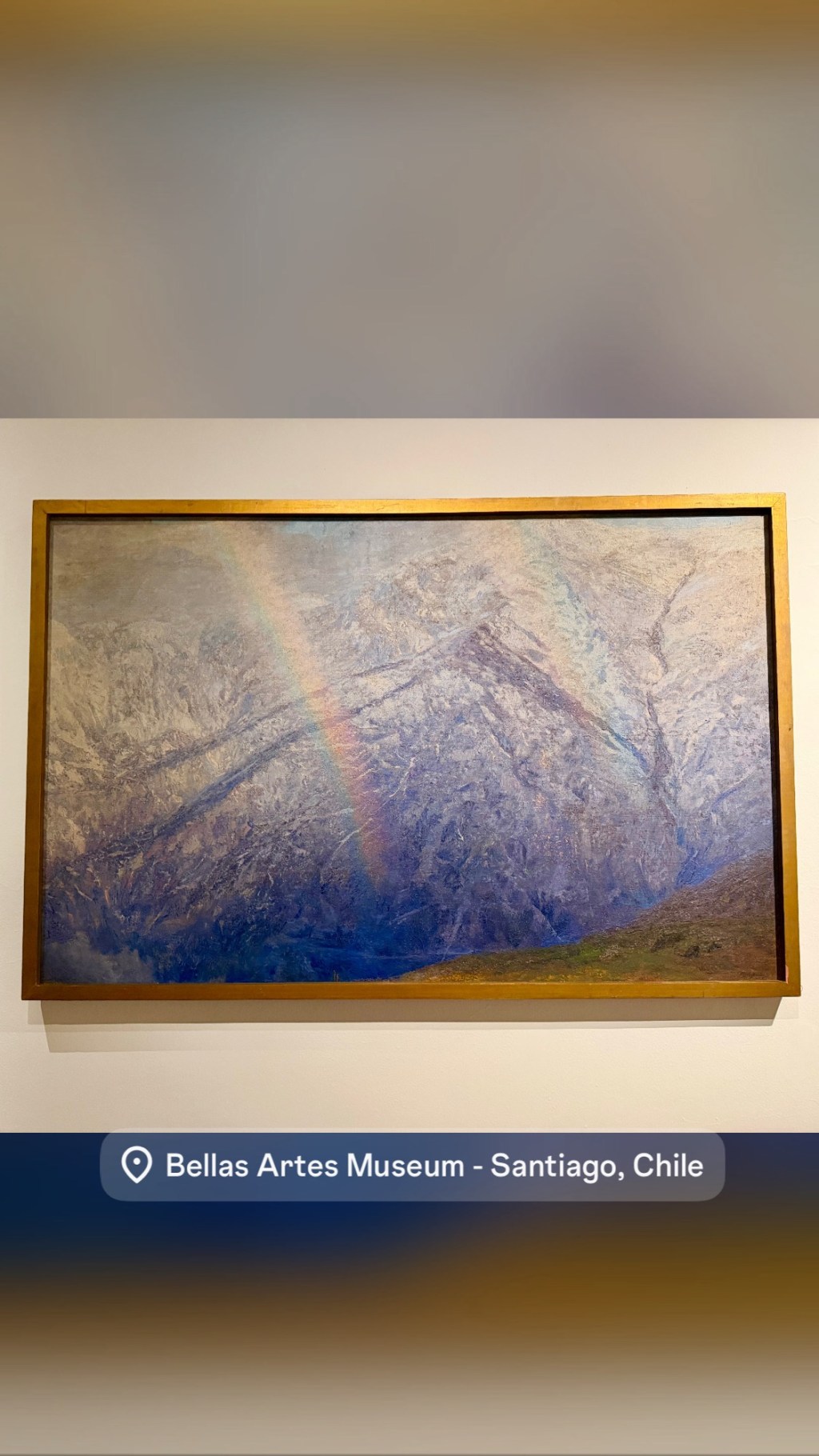
Another painting in particular struck me — Arcoíris (Rainbow) by Alfredo Helsby. It’s quite large and the feature photo of this post. I can’t tell you more about why it resonated, it just made me feel.
Observing and listening from a café table
After the museum, I did something I rarely allow myself at home: I sat at a café and did nothing in particular. No laptop, no agenda, just a drink, a notebook I mostly left closed and a view of the street. I watched and listened.
Santiago is vibrant. The sidewalks were full of young people, in singles, clusters and pairs, in conversation and in motion: students, friends and people heading to work or out to meet someone, all sharing the same few blocks and the same sense of being in the middle of things. Without understanding the words, I could still hear the city’s rhythm in the quick back-and-forth of Spanish, the laughter and the clatter of cups.
Then I looked up. Above the street, apartment buildings climb into the sky, windows stacked on windows, balconies with laundry and plants. Each window holds a household, and many likely hold generations: grandparents, parents and children sharing a home high above the city. The young people at street level were only one layer of the story. Above them was a whole vertical city, quietly living, remembering and passing things down.
It was a useful lesson in how much a place holds beyond eye level, and a real-life answer to the museum’s question about what a frame leaves at the edge.
See you soon up north.

Leave a Reply