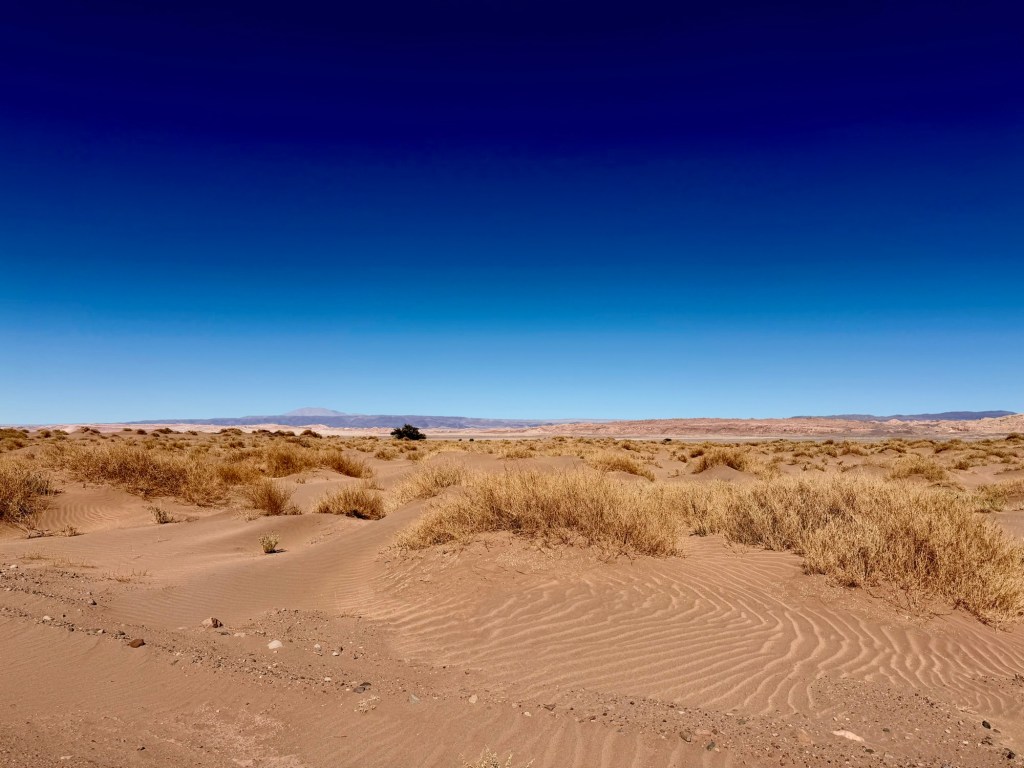
Nov. 21, 2026
Drafted from my day 1 field notes and background research.
We left in the morning from our home in Coyo, a group of us still getting to know each other, and headed to Aldea de Tulor, a village of circular mud houses a short drive from San Pedro de Atacama. It was supposed to be a gentle first outing. And it was. It got hot shortly after we left at 9 am. The sun becomes most intense, IMO, from about NOON to 6 pm here.
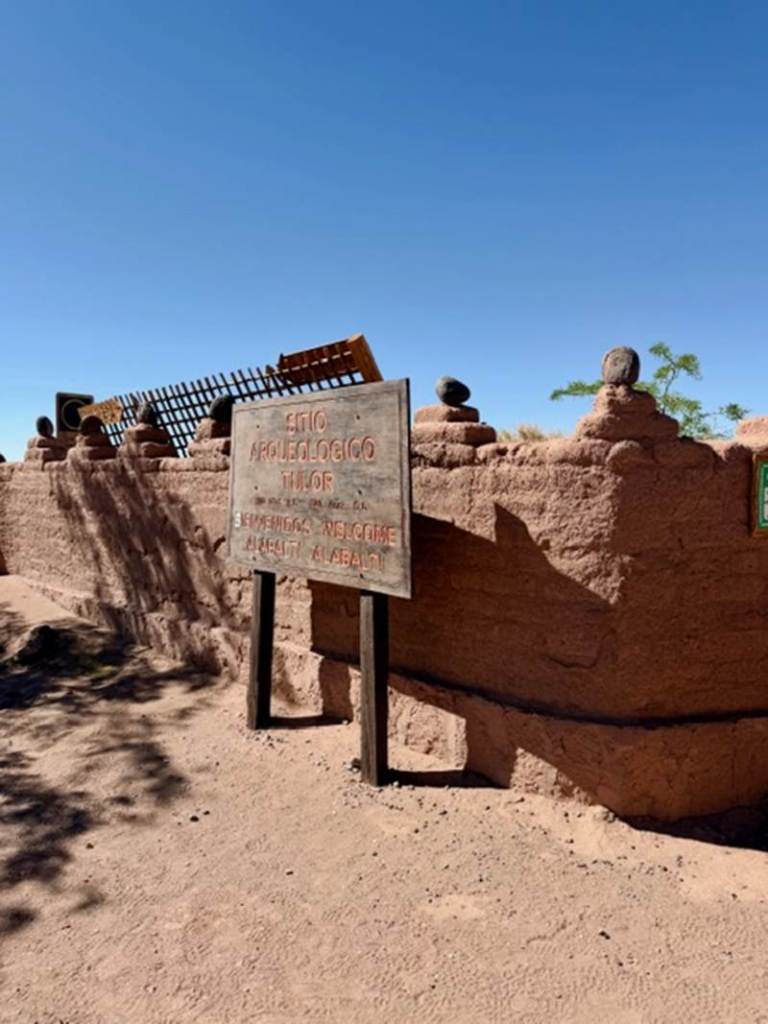
The welcome sign at the Tulor archaeological site, in front of an adobe wall under a very blue sky.
But even sweating through my shirt, I could see everybody’s curiosity coming out. We teetered single file along the small desert walkway to the museum and reconstructions of Lickanantay (Atacameño) homes. We dodged teenage tourists along the way. Somebody was always stopping to point at something, and somebody else was always stopping to look. Nobody was in a hurry to understand it. Everybody wanted to.
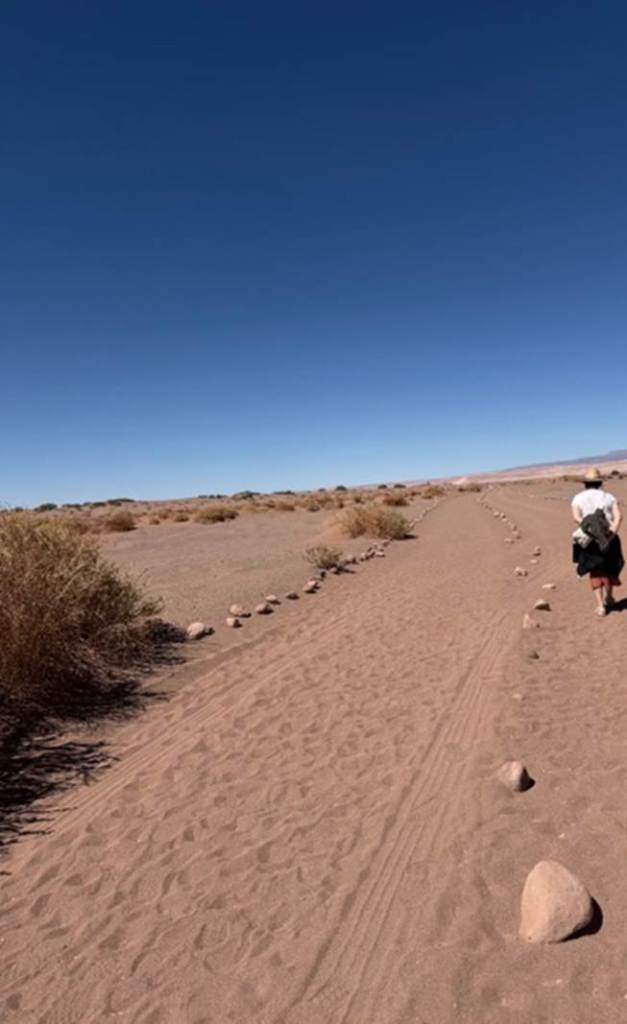
Our group walking the sandy path, with stone-lined edges and dry scrub all the way to the horizon.
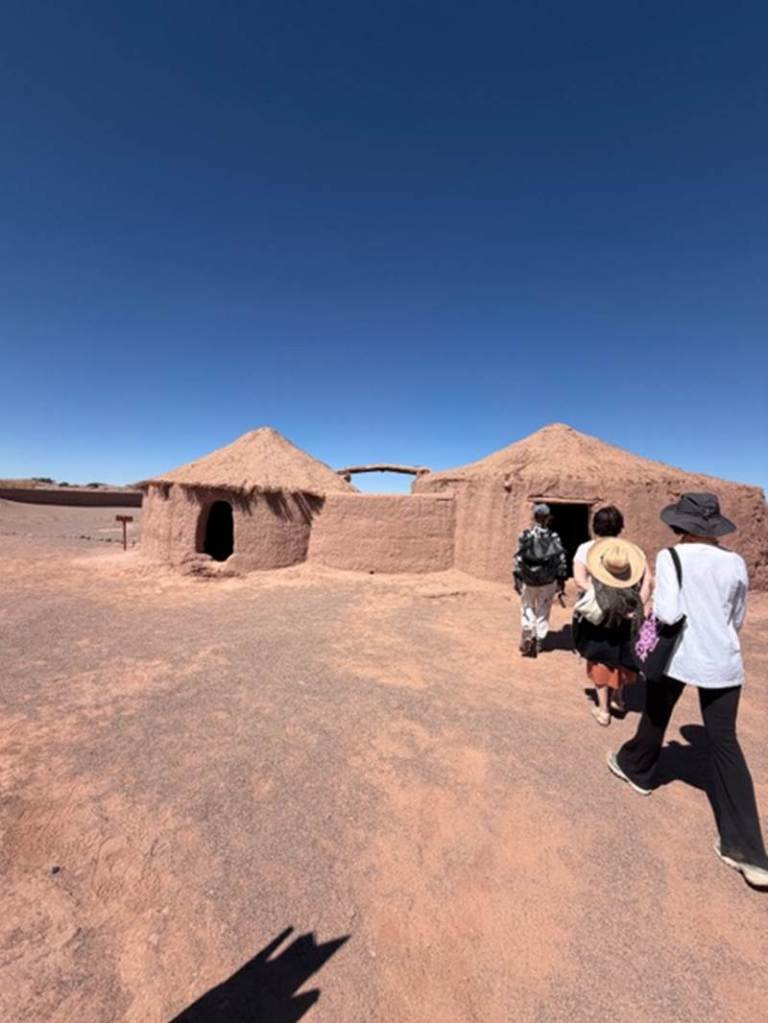
Heading toward two round, thatched-roof adobe huts joined by a low wall. My shadow made it into the picture.
I also started figuring out how to layer myself for the desert, which I did not know was a skill I lacked. I learned how much water I need at 85 degrees F. (Answer: more than I brought.) And I learned it alongside people who don’t think in Fahrenheit. A lot of my fellow residents come from countries that use Celsius, meters, and military time, so we’re all converting in real time, out loud, a little wrong, laughing about it. Everyone’s patient. It’s small, and it’s also not small at all. I’m part of this growing community of artists, activists, and curious people who can’t resist digging into nature and territory, and we get to live on this incredibly lush farm outside San Pedro while we do it. I keep thinking I should be more surprised than I am. Mostly I’m just grateful.
A village that remembers
Tulor is old, though exactly how old depends on who you ask. Dating puts the first settlement somewhere between about 380 BCE and 200 CE. A panel in the museum puts the Formative period, when village life like this took hold, at roughly 1500 BCE to 400 CE. People lived here until about 300 CE or a little after, when the oasis dried up and the dunes moved in. The village sat next to the San Pedro River, and people farmed and herded llamas. Llama caravans linked it to the Altiplano and the Pacific coast, and archaeologists have found Pacific shell beads and pottery from far away. So not isolated at all. A busy node in a network.
The sand that buried it also kept it safe, and it stayed hidden until the 1950s, when a Jesuit priest named Gustavo Le Paige started excavating. Only a small part has been uncovered. Most of the village is still underground. And here’s the part I loved: Tulor was the first cultural heritage property in Chile to be handed over to an Indigenous organization to manage. The Coyo community runs it now, and Coyo is where I’m staying. The people whose ancestors built the place get to tell its story. That feels right.
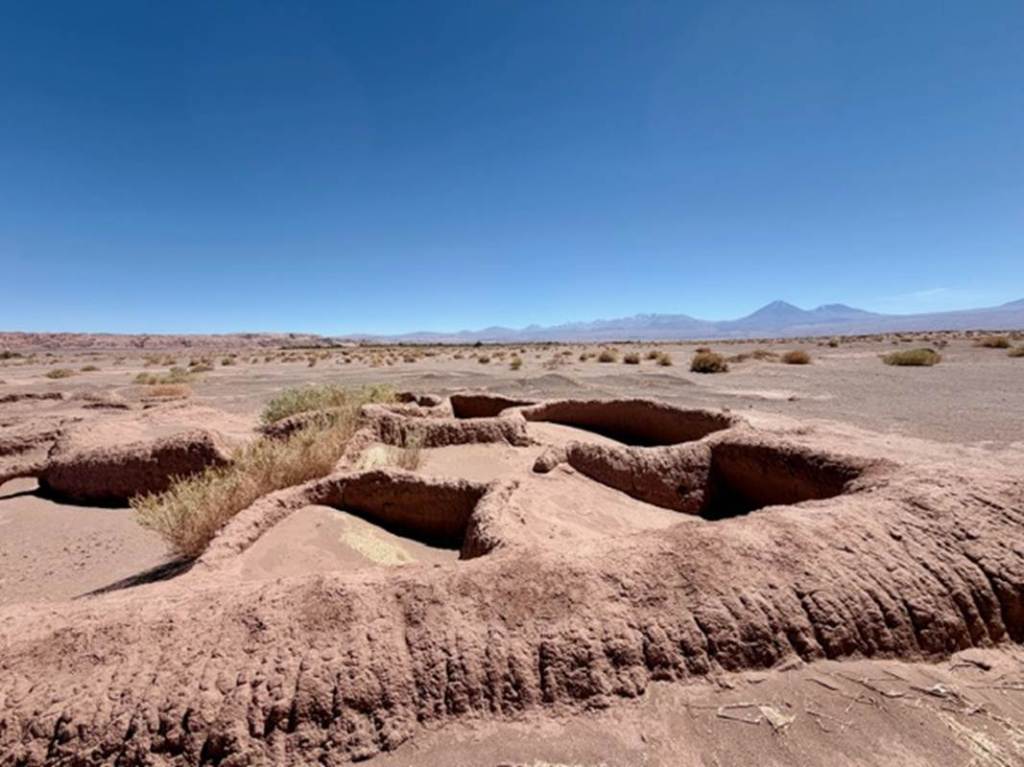
The eroded remains of the village, partly filled with sand, with volcanic peaks in the distance.
Colors of the desert
Our introduction started with color. The palette here is brown, red, and dark brown, and the textiles were made to echo the geography. Our outstanding guides talked about weaving tools, and about how people here were nomads before they began to settle and grow food. Then came a detail that stopped me: brown plates were for eating, black plates were for memories of the dead (FYI: I need to confirm I heard this correctly, as I hadn’t been given the fortuitous advice yet from a fellow resident about use of the iPhone voice recorder yet).
One object, two jobs, and the color tells you which. I’ve worked in communications a long time and I rarely see a label that good. The little museum backed me up, at least partly. A panel on Formative pottery says that from about 1500 BCE, Atacameño potters were making polished, single-color vessels, and that people at Tulor used them every day for drinking, eating, storing water, and cooking. It also says pottery was part of funeral rituals, and the dead were buried with black or red vessels like the ones in the case next to it. So black vessels and the dead go together. I still want to ask about the brown plates for eating, and about black meaning memory. [confirm]
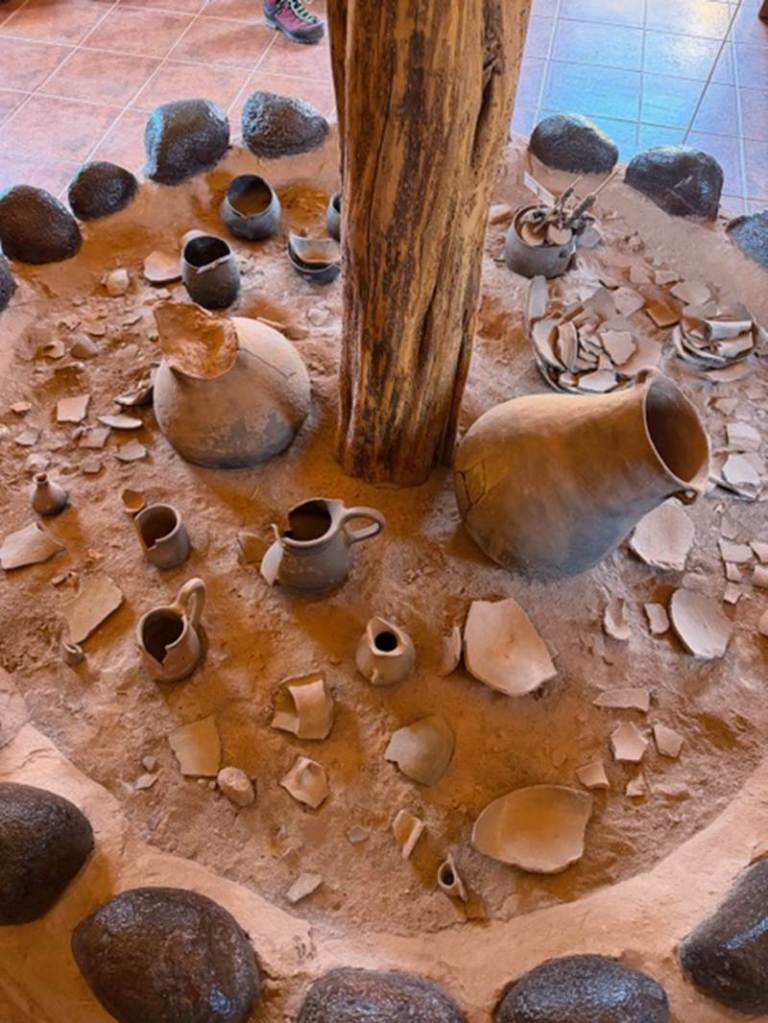
A display of clay pots, pitchers, and broken shards laid out around a wooden post.
Wind, sand, and water
I scribbled a lot about wind and sand and I want to get it right. There are two kinds of sand, one from the wind and one from the river. Wind is feminine, with two types: one moving west to east and one north to west. The river wind may be masculine. I couldn’t find a published source for any of that, which kind of makes sense. It sounds like knowledge that’s held and taught in the community, not written up for visitors. So I’m going to follow up. If one of you has the answer, feel free to comment. I also wrote that the seeds that travel on the wind survive on almost no rain, and that oasis means family.
Even that short list tells me something. This is a worldview where wind, water, sand, and kin are in relationship with each other. It’s not a list of environmental facts. It’s a family tree.
The wind was with us all day, by the way. It cooled the heat. It came hard from one side, and I wasn’t sure which until later. I think south, based on a helpful fellow resident who knew better than me how to read the sun. Once I felt it, I understood the houses.
Inside the house
The houses are round, which helps with the wind, and the thick mud walls keep the temperature steady between hot days and cold nights. I didn’t need anyone to tell me that. I stepped inside and felt it. Cool in there, walls not crumbling. Outside, hot. Instant difference.
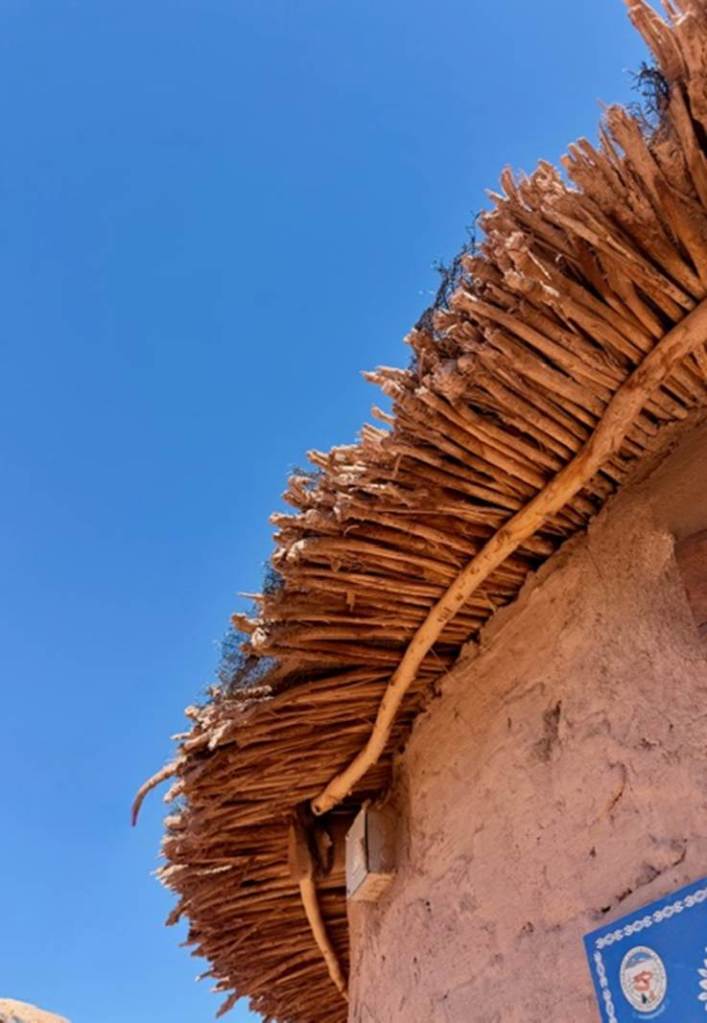
The edge of a roof built from bundled sticks, sitting on a mud-plastered wall.
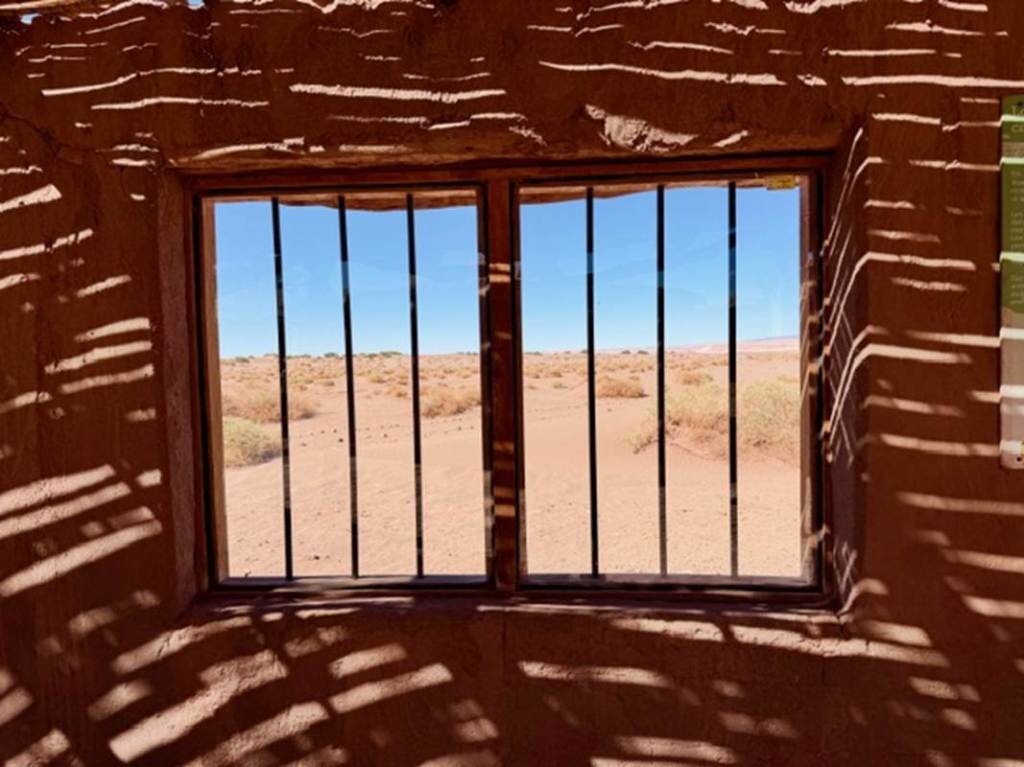
Looking out a barred window in an adobe wall to the flat desert beyond, with stripes of light and shadow across the wall. The house was very pleasantly cool inside.
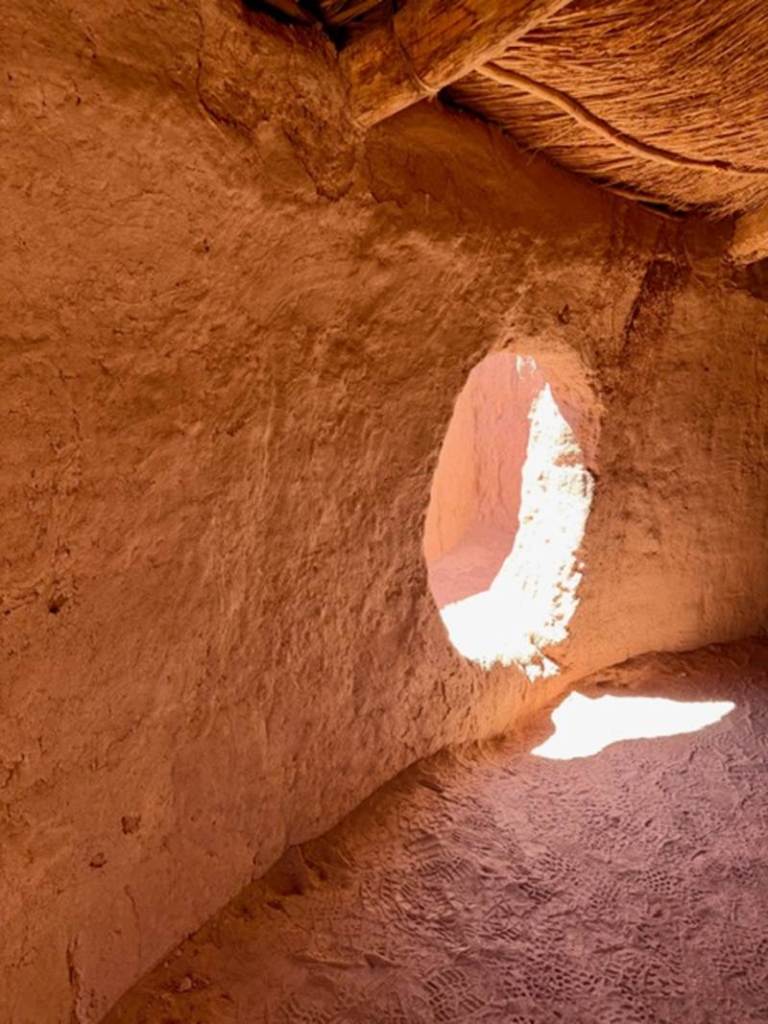
Inside: smooth orange walls, a thatch-and-beam ceiling, and an oval opening letting in a patch of sun.
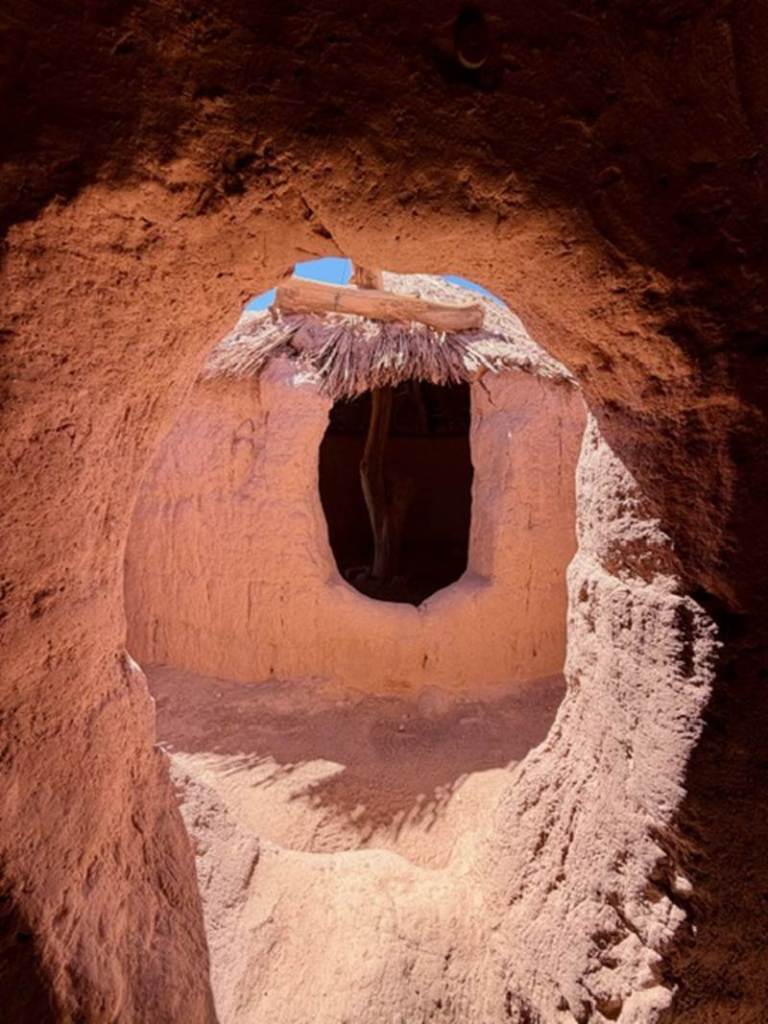
Through a rounded opening into the next small chamber, with a post and thatched overhang at the back.
A few more things our guides told us:
- The door is small because the people were small. The step at the threshold keeps water out.
- No hammers. They tied pieces together with llama neck (hide). Archaeologists have found leather, wood, and textiles at Tulor, so it fits, but I haven’t found a source online for this exact detail.
- The houses were built to face the sunrise and take in the winds.
- The small, circular cooking area represents the female uterus.
- Death wasn’t an ending. As I understood it, they believed more in a next life than in death. Sometimes parts of people were buried in the adobe of the house and in the ground, and bodies were laid in a fetal position with the hip toward the sky. A museum panel does confirm that the dead were buried with black or red vessels. I couldn’t find a reliable source for the rest, and the remains here are sensitive, so I’m treating this as how it was explained to us and I’ll check with our guide before sharing it more widely. [confirm]
I want to tread carefully here. This is what I wrote in a notebook on a hot morning, and some of it is sacred.
What the museum panels added
The little museum at the entrance did a lot of quiet work. I photographed every panel I could, partly because I can never remember dates and partly because they filled in the long story Tulor sits inside. My photos aren’t great and kind of hard to read, so I transcribed what I learned. Here’s what stuck.
- A long timeline. A poster called “La Prehistoria de Atacama” runs from the Archaic through the Formative to the Middle and Late periods. Tulor sits in the Formative.
- First people, hunter-gatherers. The earliest evidence of humans here is from around 9,000 BCE, at cave sites like Chulqui on the upper Loa river, San Lorenzo near Toconao, and Tuina near Calama, plus some small sites around the Punta Negra salt flat. They lived in the highlands, between 2,400 and 4,200 meters, where it was cooler and wetter, with streams, fruit trees, and animals we can still see today, like vicuñas and guanacos.
- Water, always water. A climate panel says the region has always been arid, but over the last 10,000 years the amount of water available to people, plants, and animals changed a lot. Between 8,000 and 4,000 BCE, all of South America went through a drier stretch, and people in the Atacama got pushed into gorges where water was still around. It uses Laguna Miscanti shrinking and growing to show it.
- Tulor as turning point. The main panel calls it one of the oldest settled archaeological sites in northern Chile, with architecture similar to sites in Bolivia, western Chile, and northwest Argentina. It describes a new way of life that produced food instead of relying only on what the environment offered, on top of a very old herding tradition. The San Pedro River drained near the site then, which made farming possible, and the community settled.
- Trade left a trail. The same panel says intense trade shows up in what’s left behind, including lots of beads made from shells. People here were part of networks that crossed the desert.
- The first rock art. One panel shows carved stone slabs with geometric designs and animals, and calls them the first rock art in the region. They were carved at the quarries where hunters gathered stone for tools, and the most important ones seem to have been carried back to the settlements for ritual use and passed down, most likely, through generations. I thought about the petroglyphs at Catarpe (more on those in a couple of posts), and the idea that art here is carried, kept, and inherited, not just made.
Tulor wasn’t the beginning, and the people here have been reading water, climate, and stone for something like eleven thousand years.
There’s a frame thing here too, and I can’t stop noticing it. What’s in the picture at Tulor is the walkway, the replica house, the few circles that have been dug out. What’s out of the picture is everything still under the sand, which I’ve seen estimated as anywhere from around 90 to 95 percent of the village. And that’s partly on purpose. From what I’ve read, the Coyo community isn’t eager for more excavation, which is a pretty direct answer to the question of who holds the frame. [confirm] Even the museum panels are a frame. Somebody picked which dates, which sites, which story goes on the wall. I’m grateful for them, and I’m also reading them as one view of a much bigger picture.
I’m Pondering Things…
A house that’s also a body. A kitchen that’s also a womb. A plate color that tells you whether it’s for dinner or in honor of the dead. The wall is the same mud as the ground, and the ancestors were sometimes part of it. Where I work, buildings and records are one thing and memory is another. Here the architecture was the memory. The information lived in the shape of the home, the color of the plate, the direction of the door, and the wind.
It connects to what I came here to learn. A community doesn’t need a report to hold its knowledge. It can live in textiles, adobe, color, and ritual, and anyone who’s taught how can read it. Which brings me back to the question I’m carrying around this whole residency: who holds the frame here, and who taught me how to look?
Reminders (for Me, Mostly) about the Residency
I should say something about how I’m actually doing, because it’s part of this story. This residency is for exploring and researching. It isn’t for finished pieces, and it doesn’t come with a clear path to something I’ll make from what I learn. I wrote about my hopes for it in my residency post: observe before concluding, listen without extracting, compare without flattening, and stay accountable to questions I don’t expect to answer neatly.
And I’m struggling with it. Every day I catch myself reaching for an outcome. A solution. A bridge between what I just saw and what philanthropy should do about it. Someone shows me a plate color and I’m already drafting the takeaway. I want to turn every moment into a deliverable, and it’s a stronger urge than I realized.
It’s hard not to be working all the time, too. I didn’t know how much of my identity is built on being useful every hour of the day. Reflecting takes force, it turns out, and I need more of that in myself than I’ve been giving it. Slow exploring and processing isn’t how I operate, and honestly it’s not how American society operates. We’re trained to produce, move on, answer the email. I’d like to get better at sitting in something and letting it sit in me, and I hope that’s a growth edge I can work on over the next three weeks.
It’s interesting to watch this play out, because I’m living with people who were raised differently. My fellow residents come from Europe, Canada, Australia, the UK, and southeast Asia, and every one of them seems to have a different relationship with time, rest, and work. I’m holding my own inherited and trained ways of being an adult up next to theirs. I don’t think mine are wrong. But I’m starting to see that they’re mine, which is different from natural.
If I had to say what Tulor adds to my case, it’s this: a community’s story doesn’t live only in documents. It lives in the shape of a house, a plate, the land itself. When those get erased, or when the people who can read them get pushed out, power piles up with whoever gets to define the place. That’s why I think philanthropy has to center land, place, and territory when it invests in narrative change and local information. It’s also why I need this time. I want to take work I’ve done for a mission and turn it into something that helps the whole field, and I’d like to grow a little in the process.
To share and remind myself how my thinking evolves day by day, I’ll end each post with something like this:
Things I’m Thinking About
- What does it mean to listen without extracting and compare without flattening when I’m trained to turn everything I see into something useful? How do I do this when experiencing a language barrier and relying on handwritten notes, research, hope that I heard something right?
- What is the intersection philanthropy plays as I continue learning about the power of the arts community and how that intersects with community need?
- Can I let this residency be exploration and research without needing it to produce an answer? And what happens if I do?

Leave a Reply