This is the third installment in a six-part series about traveling through Peru with my dad—his dream of seeing Machu Picchu, the relationship we built along the way, and what the journey taught me about place, memory, and paying attention.
Monday, May 28, began with instructions that were sensible enough to feel personally restrictive: eat breakfast before pickup, check out of the hotel, pack layers and comfortable walking shoes, and leave the large luggage behind. Our Sacred Valley group tour was scheduled for 7:35 a.m. The evening train allowed one bag per person, weighing no more than five kilograms. We were going toward my dad’s dream with overnight luggage, which meant deciding what we could live without. Apparently, most of our belongings.
The itinerary called this a full-day tour of the Peruvian countryside, with stops in Pisac, the Ollantaytambo fortress, and “other locations.” That last phrase is wonderfully unhelpful to a daughter reconstructing the trip years later. I can recover the named places and the train schedule. I cannot responsibly turn the unnamed stops into remembered visits. What remains clear is the larger movement of the day: out of Cusco, through the Sacred Valley, and toward a mountain that had occupied my father’s imagination long before it occupied our itinerary.
The Sacred Valley unfolded as a lesson in relationships: mountains directing water, water sustaining cultivation, terraces holding soil, pathways linking communities, and architecture responding to the contours of the land. It was an ambitious amount of beauty for one day. The tour listing promised six hours, but a schedule can only measure the time allotted to looking. It cannot tell you how long a place will keep rearranging your understanding afterward.
Pisac needs a little care in that reconstruction. The itinerary names the town; it does not specify which parts of the archaeological park above it we explored. The distinction matters. The present-day town occupies the valley floor, while the Inca complex extends across nearby slopes and heights, with terraces, paths, residential enclosures, ceremonial spaces, and burial areas. Learning more about that arrangement now helps me understand the landscape without pretending I remember every doorway or climbed every path.
Pisac is also known for its market, where textiles, ceramics, and jewelry form part of the town’s contemporary commercial life. I do not have a reliable memory of a particular purchase or a conversation with a maker, and I will not supply one just because it would make a pleasing scene. But the cultural distinction matters: the people living and working in the valley are not background figures in an archaeological story. A town is not simply the service entrance to its ruins. It has livelihoods, changing traditions, and a present tense of its own.
Above the town, Pisac’s agricultural terraces follow the mountain rather than demanding that the mountain become flat. Retaining walls create usable planting surfaces, hold soil, and help control erosion. Paths and channels connect the different levels. Ceremonial areas include carefully worked stone and the Intiwatana sector, associated with observation of the sun and agricultural ritual. The landscape brings cultivation, water, movement, and ceremony into proximity. These were not separate subjects neatly assigned to different departments.
I found myself watching the edges of the itinerary as closely as the named stops: plants gripping stone walls, cultivated fields arranged against steep slopes, birds moving through open air, and animals woven into daily life. Flora and fauna were not decorative additions to the archaeological story. They were part of the living system that made settlement and cultivation possible. I was, predictably, the person holding up progress to inspect something green.
The terraces were especially compelling. From a distance they appeared almost graphic—green and earthen bands drawn across a mountain. Up close, they suggested the repeated work required to make a slope habitable: building walls, managing drainage, tending soil, carrying materials, and returning to repair what weather disturbed. Their beauty was inseparable from their function. What looked like a monumental composition was also infrastructure. Someone had to understand how the place worked, and someone had to keep doing the work.
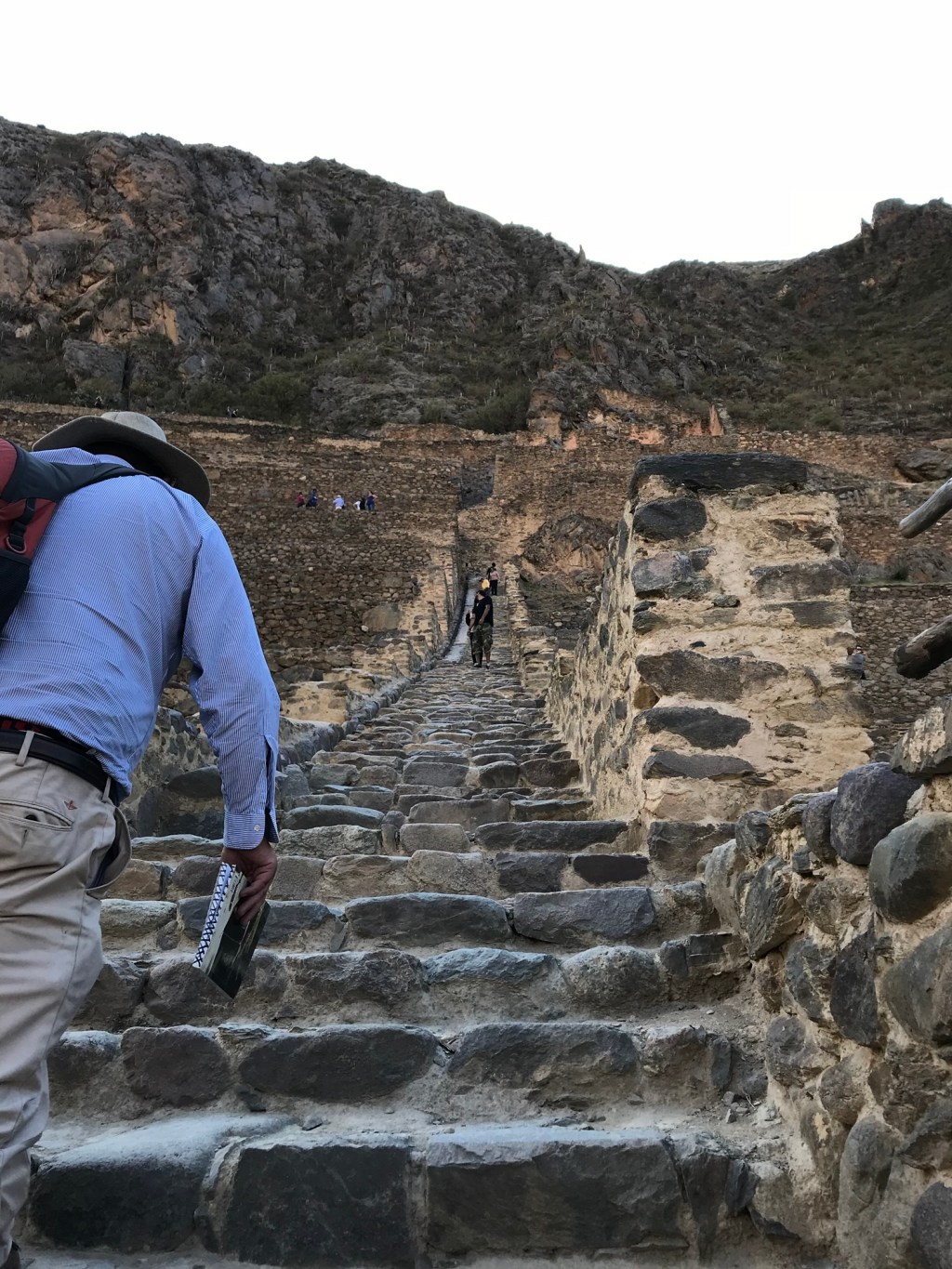
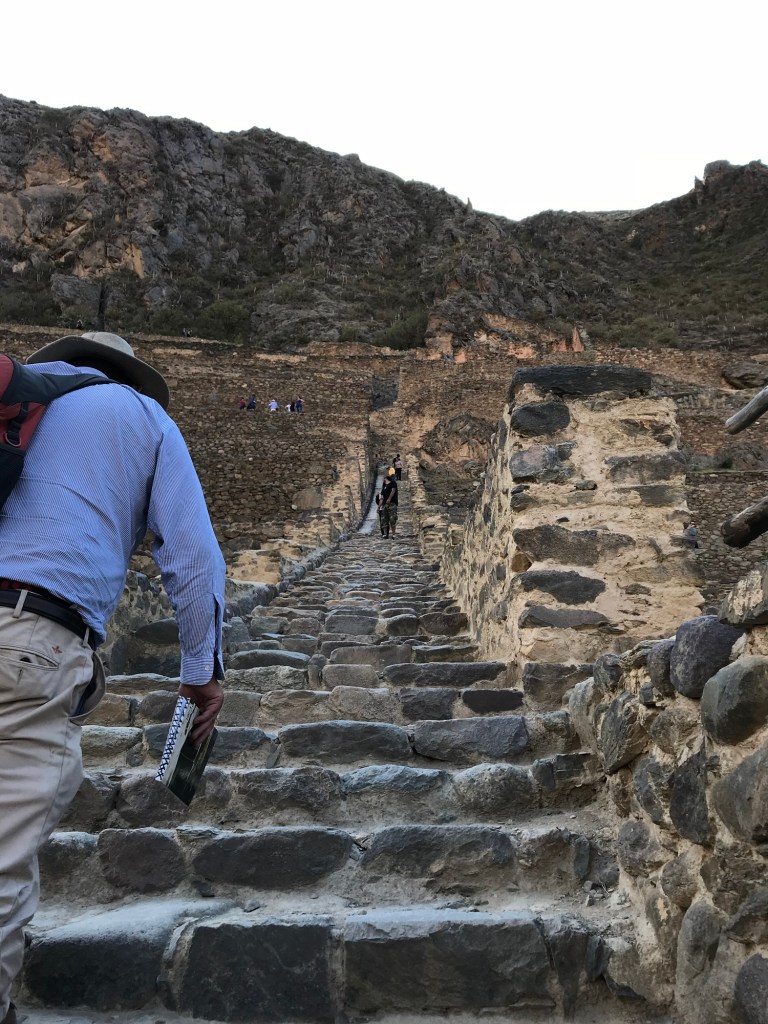
At Ollantaytambo, stone and slope seemed to converse. The itinerary called it a fortress, a description that captures its defensive history but not the whole site. Ollantaytambo also held agricultural, religious, and administrative functions. Its terraces rise above a town whose streets, walls, and water channels preserve elements of Inca planning. The land was not blank space around the architecture. It was part of the architecture—and the town below was not merely what remained after the important history ended.
The architectural details reward looking beyond scale. The upper ceremonial sector includes the enormous worked blocks associated with the unfinished Temple of the Sun. Elsewhere, fountains and carved channels show water given a precise route through built space. In the town, narrow streets and courtyard compounds organize another scale of life. Monumental stonework, water infrastructure, and domestic space belong to the same larger arrangement. I do not need to claim that we examined every feature to appreciate how much the word “fortress” leaves out.
There is power in that landscape too. Ollantaytambo was associated with the royal estate of Pachacuti and later became a stronghold of Manco Inca’s resistance to Spanish conquest. The engineering deserves admiration, but beauty does not place architecture outside politics. These buildings also speak to authority, organized labor, and conflict. Looking back, I want to hold both truths: the extraordinary knowledge embedded in the stone and the human systems that made its construction possible.
My dad’s dizziness on the steps belongs to the next installment, but it also belongs to this day. Our bodies were not separate from the architecture we admired. A terrace that looked elegant from below could become an entirely different proposition halfway up. The itinerary’s recommendation for comfortable shoes was not decorative. Neither was the water. Wonder may expand your sense of the world; it does not exempt you from having lungs and knees.
By evening, the instructions became precise again. Be at the Ollantaytambo station by 6:34 p.m. for the 7:04 departure. Our PeruRail Expedition train was scheduled to reach Aguas Calientes at 8:45. After a day of contemplating the organization of mountains, water, and stone, we returned to the smaller organizational problem of getting ourselves and our permitted luggage onto the correct train.
We had left the rest of our belongings in Cusco. As the valley narrowed around the river and darkness gathered outside the windows, we were carrying less toward the place my dad had dreamed of seeing. The itinerary promised a representative at the station and an overnight stay at Casa Andina Standard Machu Picchu in Aguas Calientes. “Overnight in Machu Picchu” was the shorthand; Aguas Calientes was where the hotel and the next stage of the journey actually waited.
Looking back, I am struck by how the day changed the destination. Machu Picchu was no longer an isolated marvel at the end of a train ride. Pisac and Ollantaytambo had placed it within a larger world of cultivation, settlement, ceremonial space, water management, and continuing community life. My work in communications keeps returning me to that same responsibility: do not crop a place so tightly around its famous image that the relationships sustaining it disappear.
At the time, we were two travelers trying to absorb more beauty than a day could reasonably hold. Now I see another inheritance in that movement through the valley: the habit of looking beyond the destination. My dad had brought a dream. The day had widened its frame. Ahead was Machu Picchu. Around us was the world that made it possible.

Leave a Reply