This is the second installment in a six-part series about traveling through Peru with my dad—his dream of seeing Machu Picchu, the relationship we built along the way, and what the journey taught me about place, memory, and paying attention. Read post 1 in the series.
My dad never slept on planes. Not “rarely,” not “unless the flight was long enough,” but never—as though sleep at 35,000 feet violated a personal code. We had flown overnight from Houston, stopped in Lima, and continued on to Cusco, ending with more than fourteen hours of airports and flying. By the time we arrived that morning, he was spectacularly jet-lagged. The guidance for adjusting to altitude was clear: take it easy, eat lightly, drink water, and try not to derail your body immediately. Cusco sits at roughly 11,150 feet above sea level, high enough that even an ordinary walk can make a newly arrived traveler feel conspicuously aware of every breath. Once we reached Casa San Blas Boutique Hotel, my dad—who did not adhere to rules any more enthusiastically than I did—went directly to sleep.
I went wandering in search of food. Being alone in an unfamiliar city has never frightened me as much as it has sharpened me. I notice more: the slope of a street, the sound from an open doorway, the pace of people who know where they are going, and the quiet negotiations involved in trying not to look entirely lost while being, in fact, entirely lost.
I found a café and immediately sat down for breakfast, which may be the purest expression of my travel philosophy: when uncertain, locate coffee and something involving eggs. A young American woman wandered in and asked whether she could sit with me, communal style. I invited her. She was a student living in Cusco at the time, and we spent a good two hours eating and talking about her life and experiences in the city.
The encounter stayed with me because it held two things that have always been true about me. I am comfortable being alone—walking alone, eating alone, following my curiosity without needing someone beside me to validate the experience. I am also happy to welcome company when it arrives unexpectedly. In a foreign moment in my life, I could sit easily with solitude and then make room at the table for a stranger.
By afternoon, my dad woke up ready to explore, apparently restored by the nap and prepared to behave as though the overnight itinerary had happened to someone else. I had already wandered as far as I felt comfortable going alone, so we rerouted once again. We climbed back toward the upper streets, and I showed him what I had found: the turns I had taken, the views that had stopped me, and the edges of the city I had tested before deciding they were enough for one solo morning. Retracing the route with him changed it. I was no longer only discovering the city; I was becoming his guide to my first impressions of it.
Cusco would give us grander sights: Qoricancha, Sacsayhuamán, Q’enko, Puka Pukara, Tambomachay, stonework fitted with extraordinary care, and water guided through built space. Our plans would shift around Corpus Christi observances and the cathedral’s closure on May 30, another reminder that the city was not a stage waiting for us to arrive. But my first meaningful experience there was smaller—a sleeping father, a solo walk, a shared breakfast, and a conversation with someone I would never see again.
That layered city was visible even before we reached the grander sites. Cusco had been the capital of Tawantinsuyu, the Inca Empire, and its historic center still carried the physical record of conquest and adaptation: Spanish colonial churches and palaces built over or into Inca foundations, with the earlier stonework continuing to hold up the later city. The result was not a tidy sequence of past replacing past. It was history stacked in plain sight.
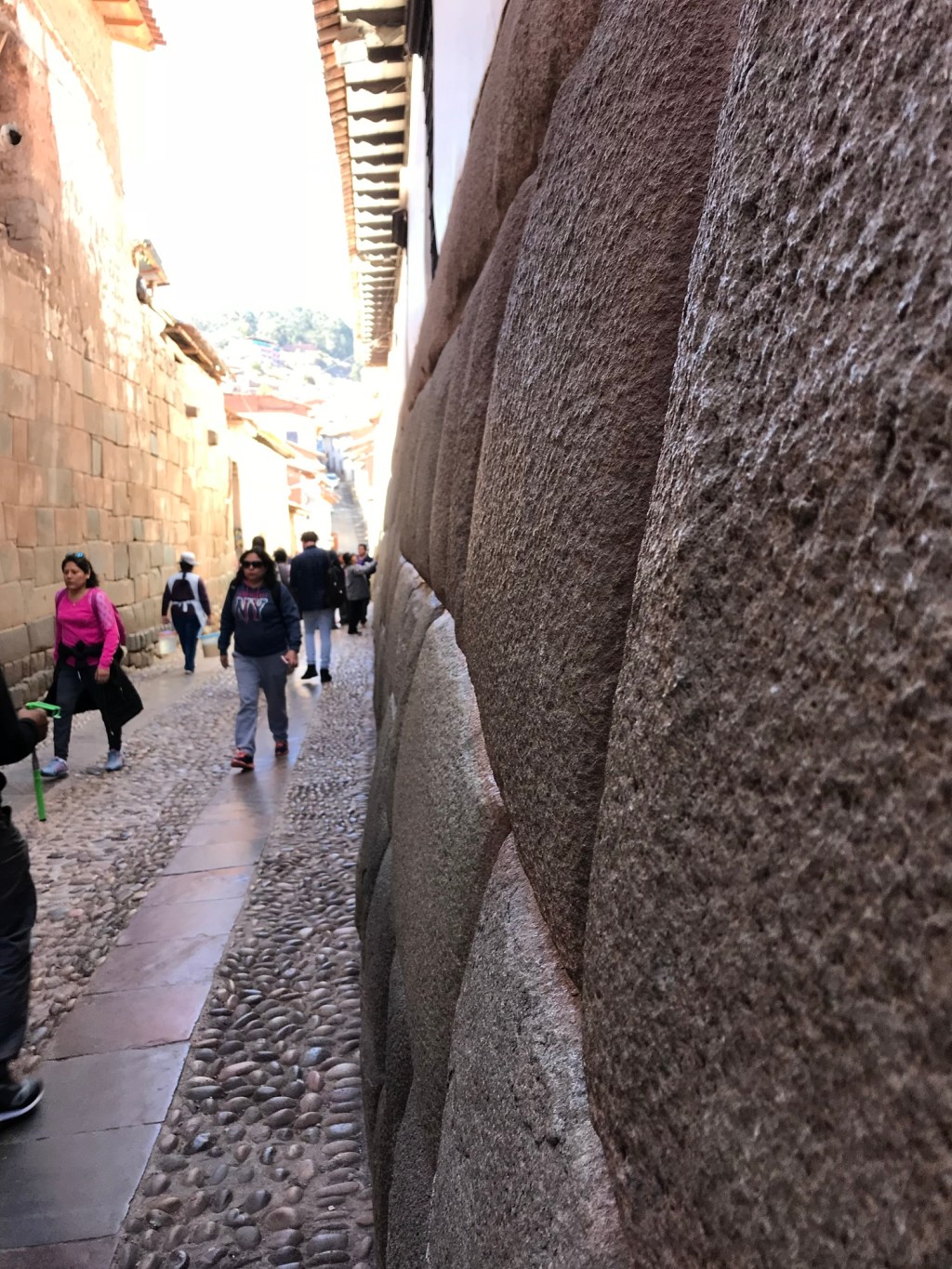
On Hatun Rumiyoc Street, we joined the visitors studying the famous Twelve-Angled Stone, fitted into the wall that once belonged to the palace of Inca Roca and later became part of the Archbishop’s Palace. Its twelve irregular sides lock precisely into neighboring stones without mortar. Guards and signs made the rule clear: do not touch the wall. Some people still reached toward it, as though a monument becomes more real only after our fingerprints are added. The restraint felt small but important. Admiration did not require contact, and survival across centuries did not make the stone indestructible.
Our guides also offered one of the more imaginative explanations for the precision: perhaps, they said, visitors from somewhere beyond Earth had lent a hand. The alien theory was presented with enough playfulness and mystery to stick in my memory, but not as established archaeology. Its appeal was easy to understand while standing before stones shaped and fitted so precisely that the workmanship seemed almost impossible. Still, attributing that achievement to extraterrestrials risks diminishing the knowledge, experimentation, organization, and labor of the Andean people who built it.
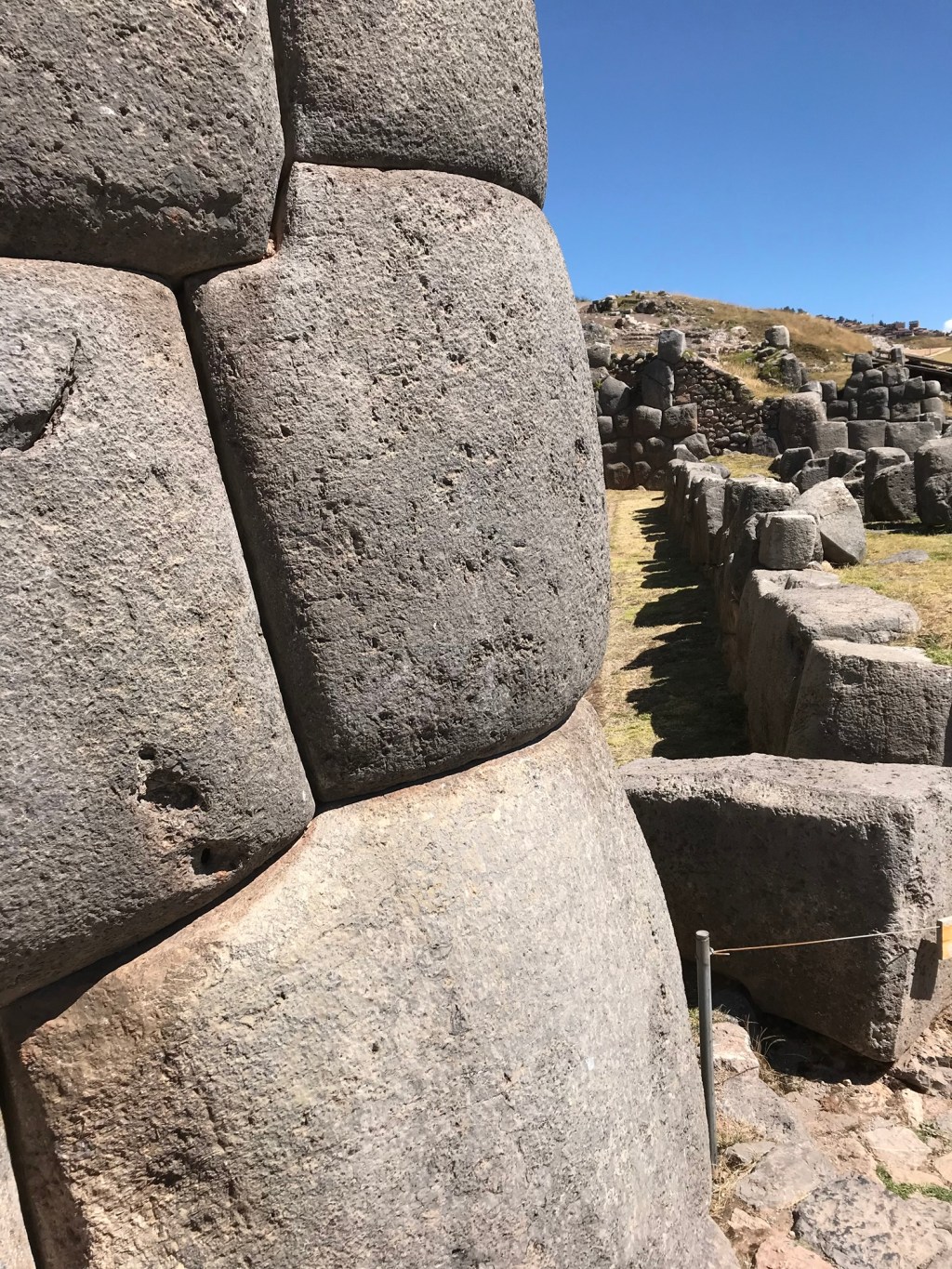
What fascinated me was not a simple idea of “perfect symmetry,” but the disciplined balance between regularity and variation. Inca masons shaped polygonal blocks individually, fitting many irregular faces together without mortar while creating walls that could flex slightly in an earthquake. Compared with the repeated columns and proportional orders familiar from Greek and Roman architecture, the immense axial plans and cut-stone monuments of ancient Egypt, or the brick arches and vaults of later European cities, Cusco’s masonry followed a different visual logic. The wall did not depend on identical units. Its coherence emerged from distinct stones made to belong together—precision expressed through relationship rather than repetition.
The Plaza de Armas offered another kind of layering. Once part of the ceremonial center of the Inca capital, it is now framed by arcades and major colonial churches, including Cusco Cathedral and the Church of the Society of Jesus. It also remains a living civic and ceremonial space—used for religious processions, music, dance, public gatherings, and festivals that bring Catholic and Andean traditions into the same square.
We arrived in the final week of May 2018, just as Cusco was preparing for Corpus Christi. The entrada was scheduled for May 30 and the central celebration for May 31. We may have seen parish groups, musicians, dancers, decorated images of saints and virgins, temporary preparations around the plaza, and crowds gathering near the Cathedral. During the festival, fifteen sacred images are carried from their parishes into the center, accompanied by bands and dancers, before circling the packed plaza. The observance was introduced under Spanish colonial rule, but in Cusco it also carries continuities with older Andean processional traditions. Even before the main celebration, the city would have been gathering itself toward it.
Looking back, this first day in Cusco also feels connected to the professional questions behind these field notes. My work in communications and philanthropy asks me to notice how places are framed, whose explanations become authoritative, and what institutions miss when they arrive with a story already written. Cusco offered all of that at once: official history and speculative folklore, Indigenous engineering and colonial architecture, public ritual and private wandering, preservation rules and the human impulse to reach out and touch. The lesson was not to turn the city into a tidy metaphor for my work. It was to pay attention to how many narratives can occupy the same place—and to remember that responsible communication begins by distinguishing observation from interpretation, curiosity from authority, and wonder from ownership.


Leave a Reply