Next week I will be in Tucson for Philanthropy Southwest’s 78th Annual Conference, a gathering of funders and philanthropic practitioners from across the region. This year’s theme, Shared Horizons, feels especially timely for me. As I prepare for the upcoming research and writing residency in the Atacama Desert, I am thinking about what place-based philanthropy requires in rural communities closer to home—and how understanding local narratives, information ecosystems, and the ways stories are told, preserved, and passed forward can deepen that work. I am interested in what becomes possible when those lines of inquiry meet: not as easy comparisons, but as invitations to see how place, power, information, and memory shape both philanthropic practice and community authority. I’m also looking forward to seeing old colleagues, as I used to sit on the Philanthropy Southwest Communications Committee for many years, and it’s been a beat since I’ve attended the annual conference.
In addition to being a good old-fashioned conference attendee, I’ll also be part of Information Is Infrastructure: Strengthening Community Trust Through Media Grantmaking, a hands-on capacity-building workshop led by Media Impact Funders. Through scenarios and discussion, the session will help funders understand how media can fit within a grantmaking strategy and how to begin building a first media grant. I’m always excited to share my own journey and experience of doing this type of work, and exploring with other philanthropic staff how they are encountering, embracing, and elevating work like this.
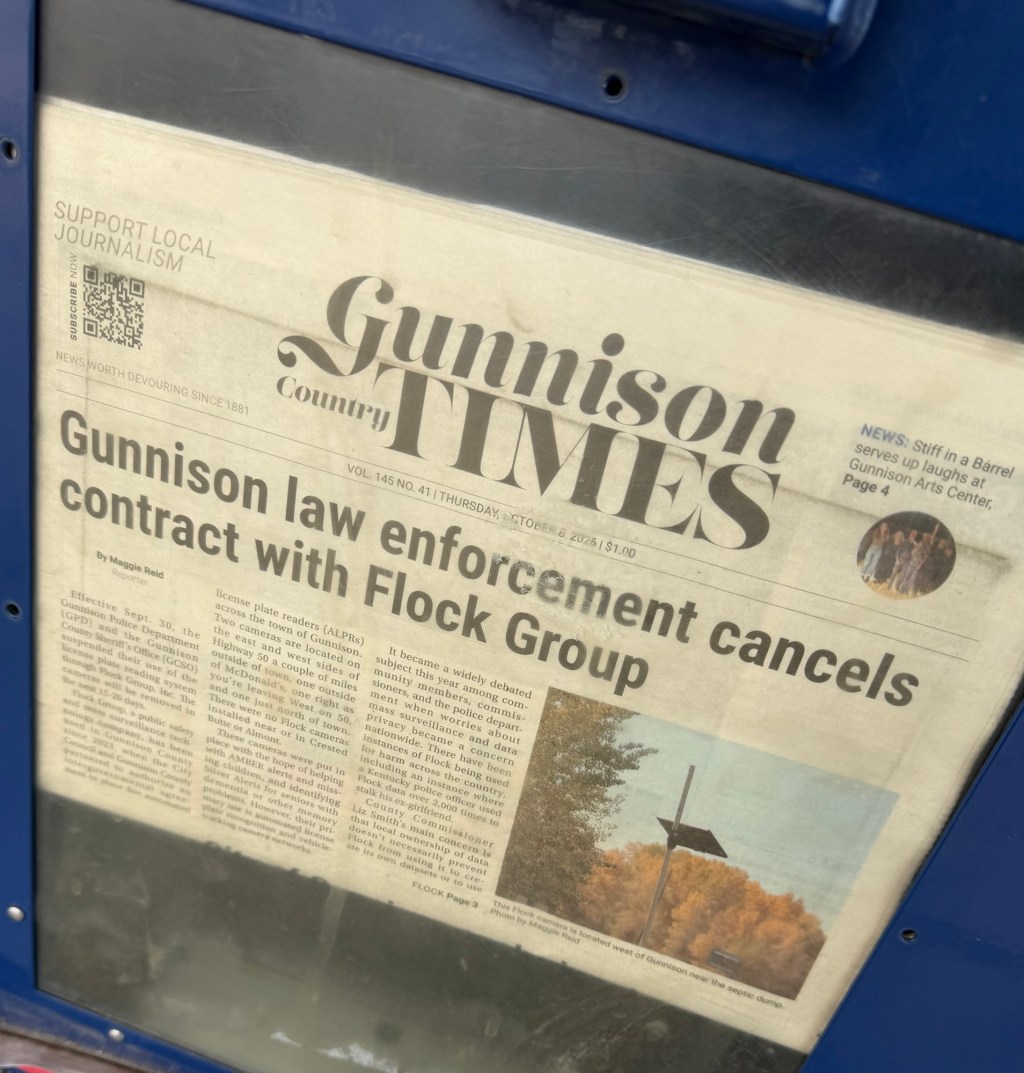
The phrase “information is infrastructure” names something I have come to believe deeply. Communities need roads, water systems, schools, clinics, and other physical foundations. They also need trustworthy information: local reporting that explains public decisions, documents community history, connects environmental conditions to health, and gives residents a meaningful way to participate in civic life. When local news weakens, communities do not simply lose content. They lose part of the connective tissue that helps people understand what is happening, whose knowledge counts, and how decisions can be challenged.
That connection is especially clear in rural places. A water table can decline for decades before the consequences become visible to everyone who depends on it. A grantmaking decision can reshape local capacity without being widely understood. A community can be represented frequently and still have little power over the story told about it. The people who live in a community might never see themselves reflected in local news because a reporter might not view them as a source above someone in a position of power. In the end, these challenges simply result in another way to invisibilize people. Media grantmaking is therefore not separate from environmental justice or community power. It can determine whether local people have the information, relationships, and narrative authority needed to shape their own future.
My role in the workshop is only one part of what I hope to learn at the conference. The broader program includes more than 48 peer-curated breakout sessions as well as workshops, learning circles, facilitated conversations, executive learning, and intentional networking. The agenda is organized around data, evaluation and learning; emerging trends in philanthropy; finance, governance and law; grantmaking and foundation strategy; innovation and technology; and leadership and talent development.
I want to move through those themes with the questions that are already shaping my writing. In sessions on data and evaluation, I will be listening for who defines evidence and whose knowledge becomes legible to an institution. What happens when community memory, oral tradition, lived experience, or relationships to land do not fit the measures a funder prefers? How can evaluation support learning without turning people and places into data points for someone else’s strategy?
In conversations about grantmaking and foundation strategy, I want to look beyond where money goes to where authority sits. My research on Chilean philanthropy has made the distinction between regional programming and genuine decentralization more visible. Funding can reach a rural or Indigenous community while priorities, timelines, and measures of success remain centralized. I will be listening for approaches that move decision-making power, strengthen local institutions, and allow communities to define what accountability should mean.
Sessions on innovation and technology may also complicate my thinking about infrastructure. Technology can extend access, improve organizational capacity, and help funders and communities use information more effectively. It can also widen gaps when tools are designed far from the people expected to use them or when technological solutions move faster than trust, governance, and local capacity. The question is not simply whether a tool is innovative, but whether it strengthens community authority and leaves durable capacity behind.
Leadership sessions matter to this inquiry for a similar reason. Sharing power is not only a grantmaking technique. It requires leaders who can tolerate uncertainty, hear disagreement without treating it as disloyalty, and change course when community knowledge challenges an institutional plan. As I prepare to enter the Atacama as a learner, I am thinking about leadership less as having the clearest answer and more as creating conditions in which other forms of expertise can shape the work.
Tucson itself offers an important setting for these conversations. Like the Atacama and much of the rural Southwest, it makes water, heat, land, migration, Indigenous presence, and adaptation impossible to treat as abstract subjects. I do not want to flatten these places into a single desert narrative; their histories and political realities are distinct. But gathering in an arid region can sharpen a shared question: How should philanthropy act when environmental change, cultural authority, economic pressure, and community well-being are inseparable?
I am also looking forward to the informal learning—the conversations between sessions, the examples that do not fit neatly on a slide, and the moments when another practitioner names a problem differently enough to change the frame. The conference theme suggests that a horizon is something we can see together without standing in the same place. That feels like an apt image for learning across foundations, communities, regions, and national contexts.
And, I can “practice pack” with limited luggage in a climate I’m not used to, such as the Atacama Desert, for example. (This is a peek into the personal nerdy, over-thinking, and over-complicated side of me who can’t stop strategizing a plan for a challenge no matter how old I get. Side note: I’m also trying to break my own cycles of perfectionism through this residency; that’s a topic for way more context, way later.)
I hope to leave Tucson with more ideas for media grantmaking and the field, but also with better questions for the residency and for my work in Colorado. How can philanthropy treat information as a public good (like I saw that the Ford Foundation announced today as a new priority in their new strategy)? How can local media strengthen rural power rather than merely describe rural need? How do institutions support community stories without claiming ownership of them? What does it look like to invest in the capacity to communicate, document, question, and remember?
Those questions connect the conference to the larger body of work I am building. Media, philanthropy, water, land, narrative, and leadership may appear to be separate subjects. Increasingly, I see them as parts of the same inquiry: who gets to understand what is happening, who gets to tell the story, and who has the power to shape what happens next.


Leave a Reply